
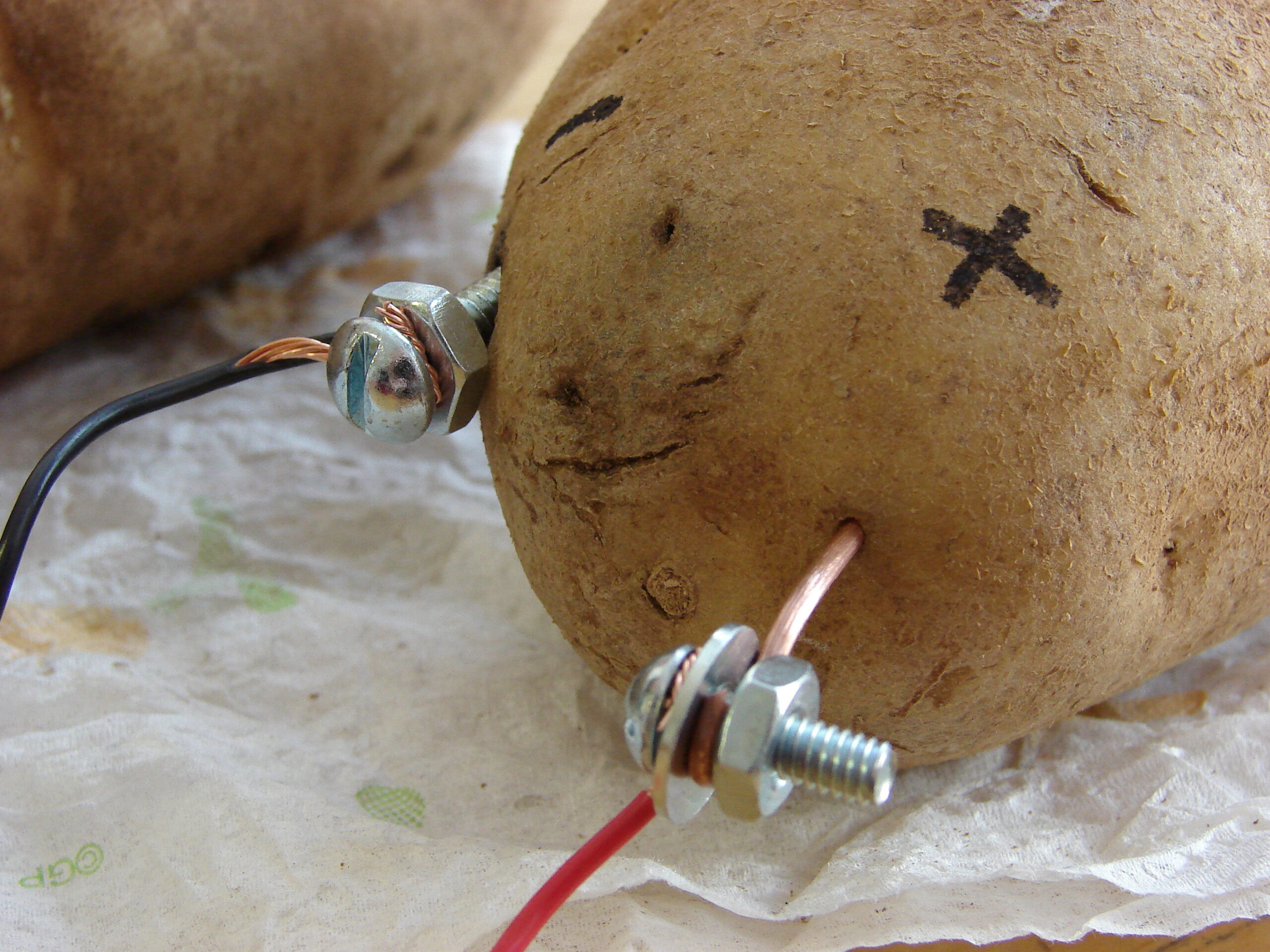

Recently, while browsing short videos on social media, I came across a clip in which somebody inserted one end of a charging cable into a potato while the other was connected to their smartphone. Then, the screen lit up and displayed the charging icon, making it seem as though the potato were supplying electricity. Excited by this idea, I wanted to write an article about this fascinating phenomenon. After all, wouldn’t it be nice if potatoes could bring us a green energy revolution?
Unfortunately, when I tried this trick at home, I quickly came to realise that my own phone did not, in fact, light up. I had been fooled by the way the video was staged and edited. Yet, you have probably seen science demonstrations or television shows in which small electronic devices, like digital clocks or LEDs, were powered by sticking wires and nails into potatoes. Are those then a hoax, too? In today’s article, we will dig deeper and get to the bottom of the real science behind potato-powered electricity.
i) The first battery
The potato battery (a.k.a. lemon battery) is a rudimentary example of an electrical battery. A battery consists of one or more electrochemical cells, which harness specific chemical reactions to convert chemical energy into electrical energy. We will examine the details of such an electrochemical process in the next section.
The first device capable of converting stored chemical energy into electrical energy, to supply a circuit with current, was developed by the Italian physicist and chemist Alessandro Volta around 1800. His device became known as the voltaic pile, while its individual units are now called voltaic or galvanic cells. The names voltaic and galvanic are nowadays used interchangeably and reflect the intertwined work of Volta and his contemporary, Luigi Galvani. In fact, Volta developed the pile in an attempt to dispute Galvani’s interpretation of experiments on bioelectricity in animals.
Volta’s ingenious device can still be admired today, as shown in Figure 1. It consisted of a stack of discs, made alternatingly from copper and zinc. Moreover, layers of cloth or paper soaked in brine, water containing a high salt concentration, were placed between successive pairs of metal discs. The whole stack was then mounted on a wooden base and stabilised by wood or glass rods.
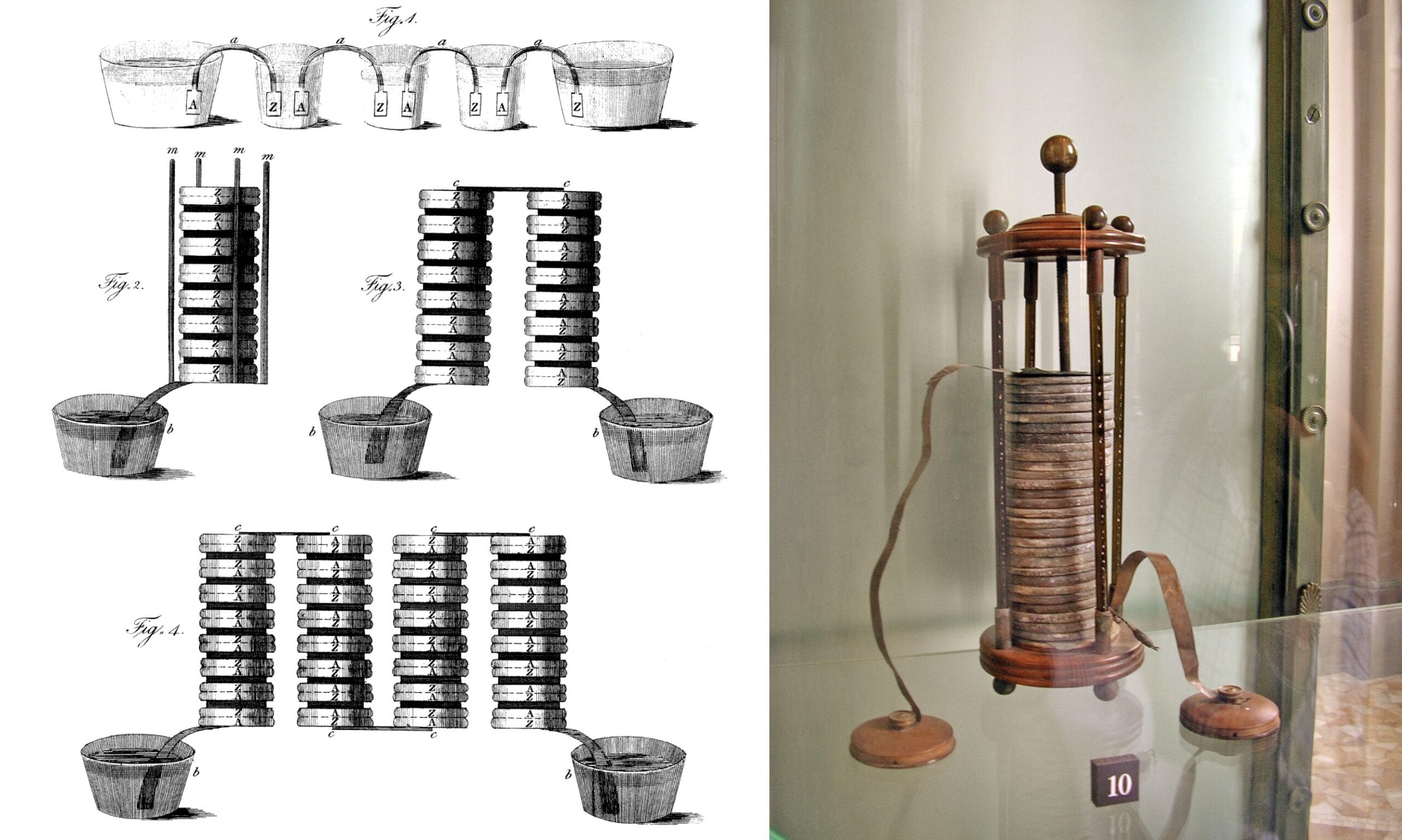


The metal discs served as electrodes: electrically conductive components, typically made of metal, at which the important chemical reactions take place. The electrode at which negative charge accumulates is called anode, while the positive electrode is named cathode. In a discharging voltaic pile, zinc forms the negative anode whereas copper acts as the cathode. Moreover, the battery can be connected to an external electric circuit by attaching conducting wires or metal strips to the electrodes.
The role of the brine is to act as an electrolyte, an essential component of any electrochemical cell. It is a substance that contains mobile positive and negative charges in the form of ions, which can move freely and thus carry charges through the cell and prevent them from accumulating at either electrode and causing an electric field pushing further charges back. Without an electrolyte, the chemical reactions generating the electric current could not keep happening continuously.
The combination of two different electrode materials and an electrolyte allows the cell to generate an electromotive force, or EMF. Measured in volts – indeed, the unit of electric potential named after Volta – the EMF describes how much energy a source can supply to a circuit per unit of electric charge. Note that stacking multiple cells increases the total EMF. As shown in Figure 1, the contacts at the top and bottom of the pile could be connected to an external circuit by conducting wires. The EMF then causes ions to carry charge through the electrolyte, while electrons flow through the external wires from the anode to the cathode, thereby completing the circuit. Despite being revolutionary for its time, the output of Volta’s stack was rather unstable, which is why this exact arrangement is no longer used today. However, the fundamental chemical and physical principles underlying modern batteries remain the same.
ii) The electrochemistry behind batteries
During the second half of the 18th century, Volta and Galvani made important contributions to our understanding of electricity and related natural phenomena. However, the chemical and physical principles underlying the devices they studied were not fully understood at the time. Volta did not realise that chemical reactions in his pile were the source of its electrical energy. Instead, he believed that contact between two different metals generated an “electrical tension”, which we nowadays call voltage, while the liquid merely acted as a conductor. [1] While contact potentials do exist, the problem was that Volta’s theory did not correctly identify the chemical reactions as the source of the pile’s electric energy. The modern electrochemical interpretation was developed over the following decades, largely through the work of Humphry Davy and Michael Faraday. [2]
So, where does the electrical energy really come from? The working principle of simple batteries, including the voltaic pile and the potato battery, is based on a particular kind of chemical reaction known as an oxidation–reduction, or redox, reaction. In a redox reaction, the oxidation states of one or more atoms change. An oxidation state is a bookkeeping number used to track how many electrons an atom has formally lost (or gained) compared to its neutral elemental state. An atom that has lost or gained electrons in this way is called an ion. An increase in oxidation state is known as oxidation, implying the loss of electrons, while a decrease means reduction, or the gain of electrons. The terminology may be somewhat confusing, as oxygen atoms generally show reduction, not oxidation. The reason for the name is that other atoms that show oxidation consequently may attract reduced oxygen.
Oxidation and reduction always occur together in a redox process: the electrons released by one reagent during oxidation must be accepted by another compound during reduction. In a discharging battery, these two processes take place at separate electrodes. Oxidation occurs at the negative anode, releasing electrons, while reduction occurs at the positive cathode, accepting them. Separating the two reaction sites in space, i.e., installing the electrodes in different positions, forces the electrons to travel through the external circuit, producing a usable electric current.
Below, Figure 2 illustrates this process in a copper–zinc cell containing sulfuric acid (H₂SO₄) as its electrolyte. When dissolved in water, sulfuric acid forms a conducting solution containing mobile positive and negative ions. In the simplified model used here, these are represented as hydrogen ions, H⁺, and sulfate ions, SO₄²⁻. The two electrodes do not touch each other; instead, they are immersed in a common electrolyte and connected by an external wire.
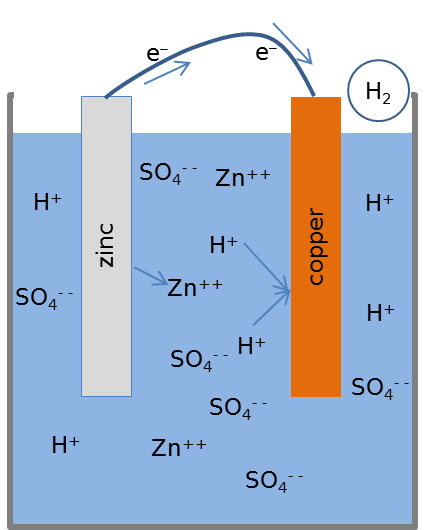

During oxidation, each zinc atom releases two electrons and enters the electrolyte as a positively charged Zn²⁺ ion, or cation. The released electrons remain in the zinc electrode, which forms the negative terminal of the battery.
Oxidation: \( Zn \rightarrow Zn^{2+} + 2e^{-} \)
At the cathode, positively charged H⁺ ions accept electrons from the copper electrode. This reaction produces bubbles of hydrogen gas, H₂, at the cathode’s surface. The copper itself is, however, not reduced and thereby consumed; it rather acts as a conductor and provides a surface for the reduction reaction. This then becomes the positive terminal of the battery.
Reduction: \( 2H^{+} + 2e^{-} \rightarrow H_{2} \)
Finally, combining the two half-reactions gives us the overall redox reaction:
Overall reaction: \( Zn + 2H^{+} \rightarrow Zn^{2+} + H_{2} \)
Because the two half-reactions occur simultaneously, the electrons released at the zinc anode flow through the external wire to the copper cathode, where they are accepted by the H⁺ ions. This movement of electrons through the external circuit produces the electric current.
The overall redox reaction in this cell converting chemical into electrical energy is spontaneous, meaning that it proceeds without an external energy input. However, not all redox reactions are spontaneous. The counterpart likewise exists and is known as an electrolytic cell, which uses electrical energy to drive a redox reaction that would not otherwise occur. One example is the electrolysis of water, in which a high external voltage causes water to decompose into hydrogen and oxygen:
Electrolysis of water: \( 2H_{2}O \rightarrow 2H_{2} + O_{2} \)
This balanced chemical equation shows that two molecules of liquid water decompose into two molecules of hydrogen gas and one molecule of oxygen gas. Unlike the reaction in a voltaic cell, this process is not spontaneous and therefore requires a continuous input of electrical energy to keep happening.
iii) So, can you charge your phone using a potato?
Equipped with this new knowledge of electrochemical processes, let us analyse how a potato can form part of a battery. It is important to remember that a potato by itself is not a source of electrical energy. However, we can turn it into a rudimentary copper–zinc cell by inserting two different metal electrodes. As shown in figure 3, a zinc (or zinc-coated) nail or screw can serve as the anode, while a copper coin or wire acts as the cathode.
The potato itself fulfils the role of the electrolyte, as well as physically keeping the electrodes apart. Its watery plant sap contains dissolved weak organic acids, as well as mineral ions. These mobile ions allow charge to travel through the potato. Similar batteries can be made using various fruits, particularly citrus fruits such as lemons and oranges, because their juice contains relatively high concentrations of citric acid.
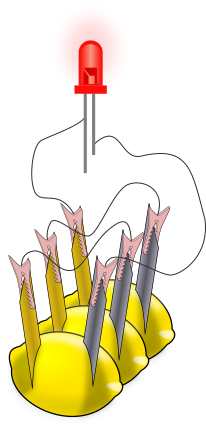
As before, at the zinc anode, zinc atoms are oxidised to Zn²⁺ ions, releasing electrons, and at the copper cathode, hydrogen ions in the potato accept these electrons. When the electrodes are connected by wires through an electrical load, such as an LED, the released electrons flow from the zinc to the copper, forming a closed circuit and making the light shine.
According to an article by the Royal Society of Chemistry, a single potato cell with zinc and copper electrodes can produce an open-circuit voltage of around 1 V. [4] This means that the voltage is measured without an energy-consuming device, or electrical load, attached. If there is load, the effective voltage decreases significantly. To counteract this, the battery performance can be improved by choosing different electrode materials and electrolytes. For example, open-circuit voltages of 1.5–1.6 V have been measured in lemon cells using magnesium and copper electrodes. This is comparable to the nominal voltage of a standard alkaline AA battery, which is approximately 1.5 V.
When several cells are connected in series, as illustrated in figure 4, they can even produce enough voltage to power small, low-current devices such as buzzers and calculators. The authors of [3] present a list of electronic devices powered by lemon cells, the number of cells needed for each device, and experimental details for cells using zinc–copper and magnesium–copper electrodes.

Surprisingly, a lemon battery can keep going for longer than you might think. In a demonstration at the University of Iowa [5], a fresh lemon with zinc and copper electrodes produced an open-circuit voltage of about 0.89 V. A day later, the reading had actually risen to 0.98 V, which researchers attributed to some of the metal dissolving into the lemon flesh. This increased the concentration of ions in the electrolyte, thus improving the battery performance. While their lemon-battery supplied too little current to turn a motor directly, it could charge a small one-farad capacitor. After around twenty minutes of charging, the capacitor could run a small electric motor for about fifty seconds.
Unfortunately, even when combined, a small number of fruit or potato cells cannot supply enough current or a sufficiently stable, regulated voltage to power heavier loads, like an incandescent light bulb or a smartphone. (There are other obstructions, related to technical details of the charging cable. If you are curious, I recommend watching this YouTube video by Science Buddies. It demonstrates that three potato cells connected in series can, likewise power, an LED. Moreover, it gives instructions for your own experiments, and a more detailed explanation about the aforementioned technical obstructions to potato-based phone charging.)
Even so, there could still be a lot of potential to be gained from potatoes! As described in this article by the BBC, researchers have produced substantially more powerful cells by placing slices of boiled potato between the electrodes, rather than inserting the electrodes directly into a raw potato. This is because boiling breaks down the potato tissue and reduces its internal resistance. This allows ions to move more easily, thus reducing the energy lost as heat and making the battery more efficient. Given that LED lamps are inexpensive and require relatively little power, the boiled-potato approach could become a possible source of low-cost lighting for off-grid communities without reliable access to electricity. So, while a single potato cannot charge your phone, it is fascinating to know that there is ongoing research into how potato-based electricity may help improve people’s lives in places where conventional electricity sources are unreliable or absent.
References:
[1]: Chang H. Dead or “undead”? The curious and untidy history of Volta’s concept of “contact potential.” Science in Context. 2021;34(2):227–47. doi:10.1017/S0269889722000199
[2]:The Royal Institution. “Alessandro Volta’s voltaic pile.” Royal Institution Collection. Royal Institution
[3]: Swartling DJ, Morgan C. Lemon cells revisited-The lemon-powered calculator. Journal of chemical education. 1998 Feb 1;75(2):181-.
[4]: Ashworth, Stephen. “Batteries and electrochemical cells.” The Mole, Royal Society of Chemistry, 1 January 2014. RSC Education
[5]: University of Iowa, Department of Physics & Astronomy. “Lemon Battery” (demonstration 5E40.25). Instructional Resources and Lecture Demonstrations.