
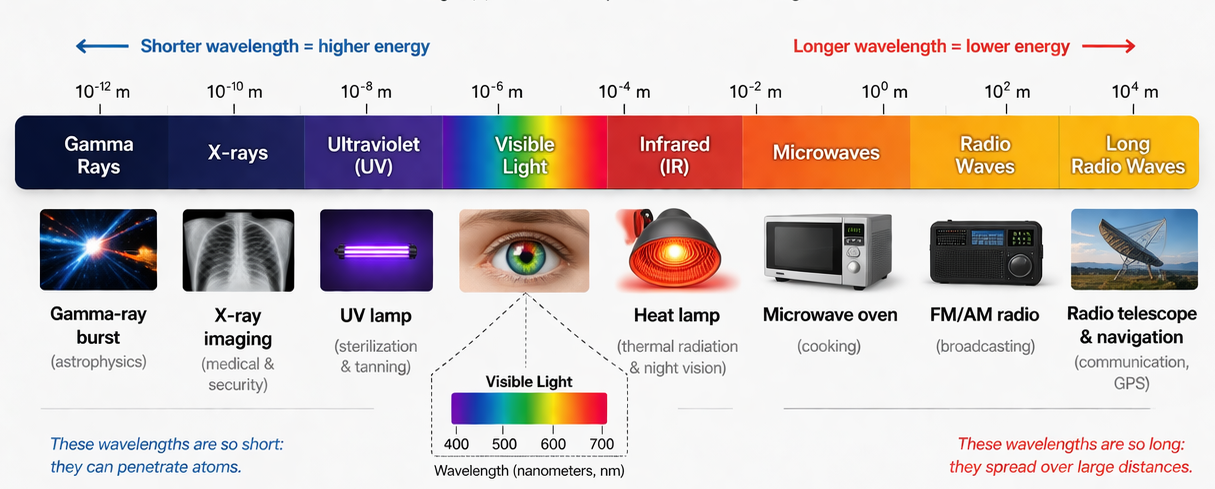
The energy of electric and magnetic fields travels through space as waves.These waves vary in energy and wavelength, thus producing an entire spectrum of electromagnetic radiation. Highly energetic waves, like X-rays, have very short wavelengths and high frequencies and can even pass through materials. Lower-energy waves, such as microwaves, are used to transmit signals over long distances; an example would be the 5G signals that keep your phone connected. In the image below, you can see an overview of the electromagnetic spectrum.
As stated in a previous article by Cintia Perugachi Israels on colour vision, only a small part of this spectrum (roughly from 400 to 700 nanometres) is visible to us humans. Some colours, like each of the rainbow colours, correspond to a single specific wavelength. For instance, monochromatic blue light has a wavelength around 450 nm. However, there are also many colours, like magenta or cyan, which do not correspond to a single wavelength but are rather a combination or mix of the “primary” light colours red, green, and blue.
But how do our eyes detect visible light at different wavelengths so that we can see colours? At the back of our eye lies the retina, a thin layer that is typically filled with light-sensitive cells called photoreceptors. There are two main types: first of all the rods, which are very sensitive and help us see in low light, while being insensitive to different colours. Colour vision, on the other hand, relies on the cone cells, which work best in brighter conditions. (This is why it is more difficult to see many colours when it is dark outside.)
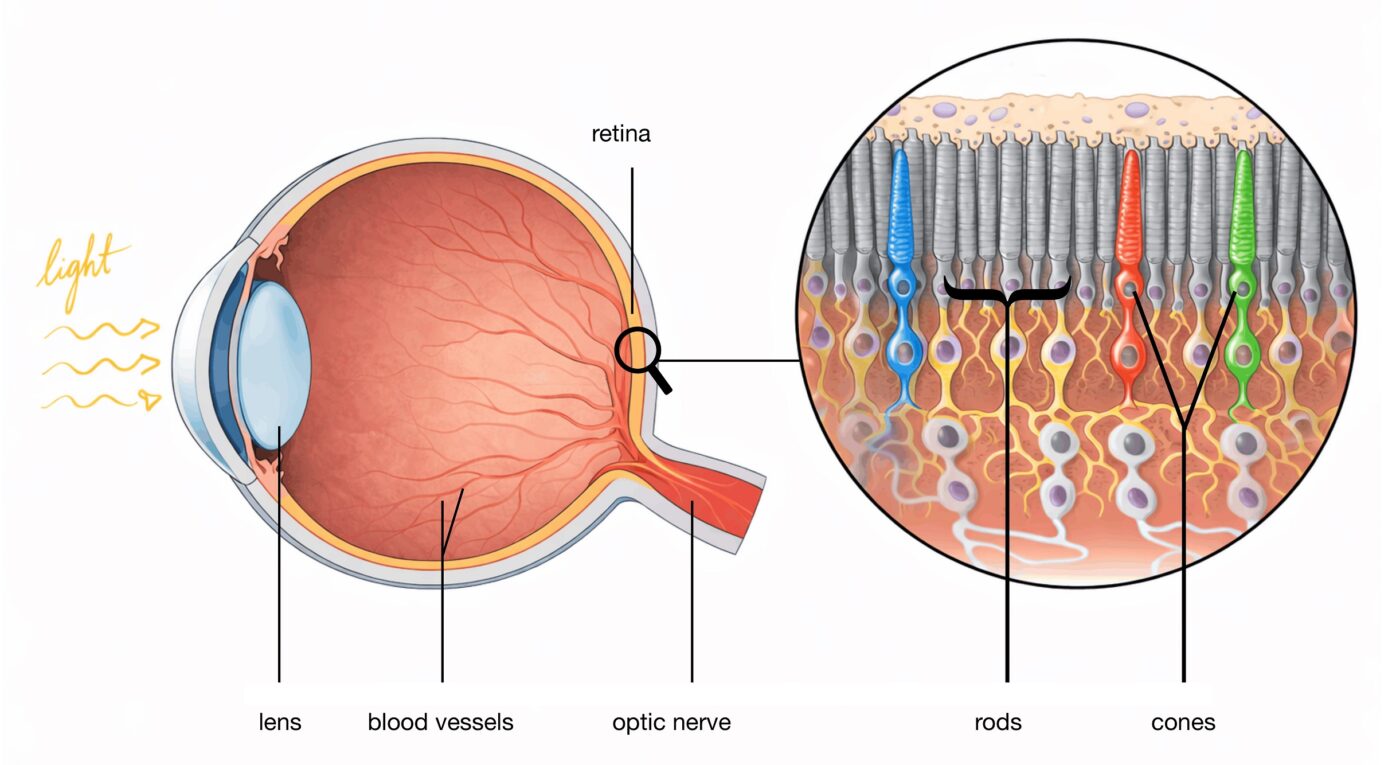


To ensure that we can see the world in all its beautiful colours, our retina typically contains three types of cones, each finetuned to a different range of wavelengths. For example, S-cones (S for short) detect light at the smallest visible wavelengths, i.e. blue. The M-cones and L-cones respectively detect medium and long wavelengths, corresponding to green or red light.
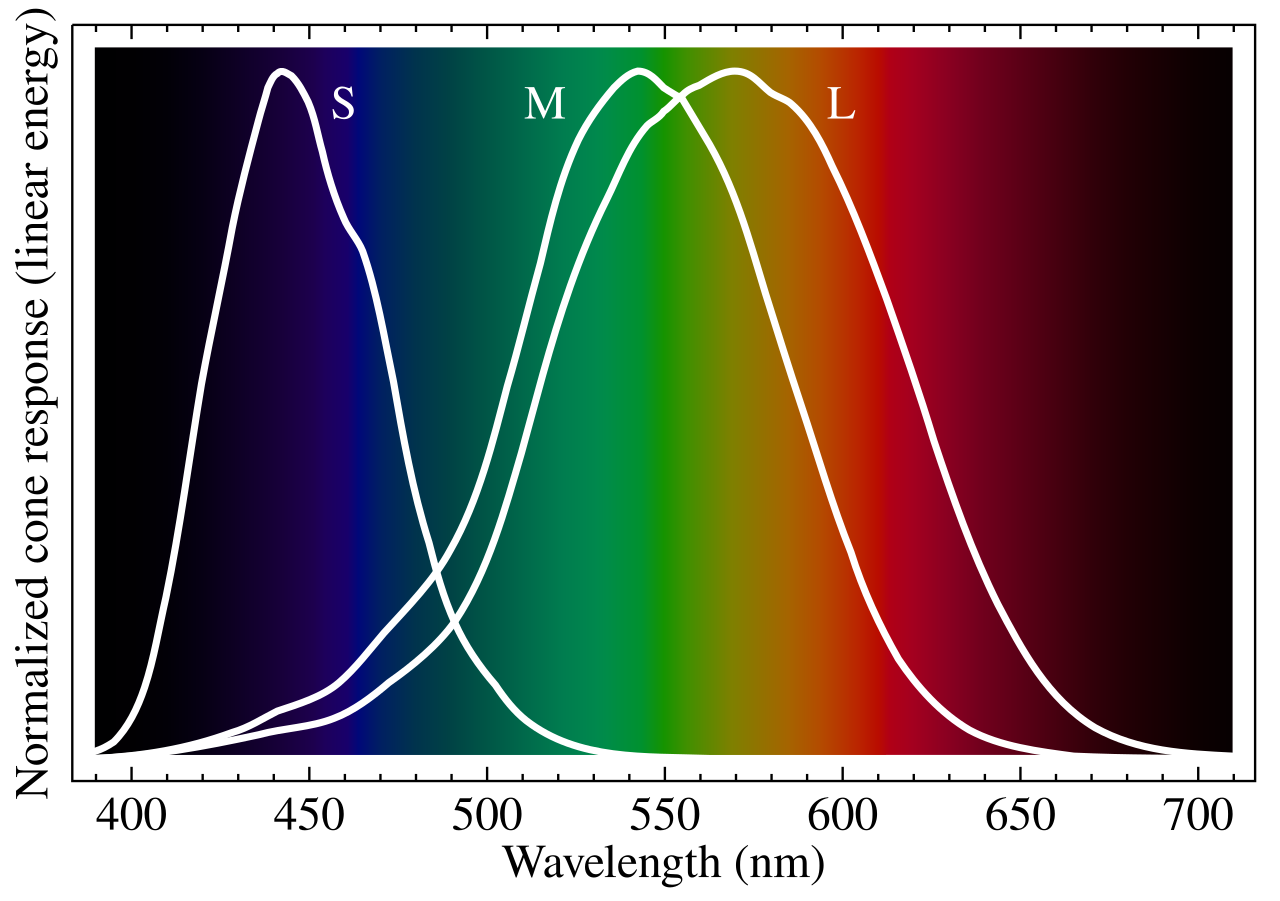

Each colour that we can see is thus essentially a unique and characteristic combination of red, green, and blue signals. (You might have seen “RGB” colour codes on your computer or TV screens). Thus, every colour that we can see is essentially defined by the characteristic relative activity of the three cone types. However, in everyday life light is almost never “pure”, but rather always a mixture of different wavelengths. Even “green” light, as reflected from trees or grass, for instance, usually contains a mix of different wavelengths, including some more red or more blue hues. Moreover, the spectral sensitivity curves of the different cone types overlap substantially. Thus, when green light hits the retina, it is common that multiple cone types are activated to some extent, rather than just the M-cones. This raises an interesting question: what would happen if only the M-cones were activated in isolation? Would this kind of highly specific stimulation, which is not achievable by natural light sources, result in the perception of novel colours?
In 2025, researcher Ren Ng and his team from the University of Berkley, California set out to test exactly this.[1,2] As shown in figure 3, M and L cones share a big overlap in the green to yellow region of the visible spectrum. As a consequence, in natural light, there is no single (or “monochromatic”) wavelength that only excites the M cones without also stimulating the L cones.
Using a novel technique named Oz, which is run using a software called “wizard’, the researchers were able to map out the positions of different cone cells in the retina of each participant. Using this spatial information, the researchers could subsequently target individual cone cells in the retina with precisely controlled laser light. This allowed them to stimulate the M-cones using a green laser with a wavelength of 543 nm, without activating nearby L-cones. Under these conditions, participants did however not see ordinary green. Instead, they reported a striking blue-green colour which does not exist in the natural visible spectrum.
To understand what participants were seeing, the researchers asked them to compare the colour to light of a single wavelength (for example, “pure” red or blue). All five participants of the study reported something unusual: a colour that could not be matched to any specific real wavelength. This new “fictitious” colour, which was described to have an “off-the charts saturation” has been dubbed olo.[1] The saturation of a colour is a measure of its intensity. You could think of intense bright colours, e.g. on a neon sign, as being highly saturated whereas more faded or “washed-out” colours have a lower saturation.
Participants described olo as similar to teal or peacock blue, but far more intense and more saturated than anything they had ever seen before. In fact, to match it to a natural colour, they had to reduce the saturation by “diluting” it with white light. As one researcher put it, olo appeared “more intense than even the most vibrant blue-green in normal vision.”[2]

It is an impressive feat that the researchers managed to create the perception of an entirely new colour, just by stimulating the retina in a way that never occurs in nature. However, the Oz technique can do even more than that. By precisely controlling how strongly each type of cone is stimulated, it can recreate the cone-activation-patterns the brain normally associates with different colours, even when using just a single wavelength of laser light. In this way, the researchers were able to trick the brain into generating full-colour visual experiences using only one particular wavelength, i.e. “colour”, of laser.
Looking ahead, this approach could have important applications. One idea is to use it to help people with colour blindness, which is usually caused by the malfunctioning or absence of certain cone types. In principle, using methods like Oz, it might be possible to make existing cones mimic the missing ones by carefully controlling how they are stimulated. The brain could then receive the missing information and perhaps learn how to interpret it as colours over time.[2] That said, this research is still in its early stages. For now, the technique works only over a small part of the visual field and requires highly specialised, expensive equipment available in just a few labs. Still, it is an impressive first step and a glimpse of how flexible our perception of colour might really be.
If you are curious about what the world looks like for someone with colour blindness, you can visit this website, which simulates different types of colour vision deficiencies. It also proposes some accessible colour palettes which can be useful when designing illustrations or websites.
References
- Fong, James, et al. “Novel color via stimulation of individual photoreceptors at population scale.” Science Advances 11.16 (2025): eadu1052.
- Gibney E. Brand-new colour created by tricking human eyes with laser. Nature. 2025 May 1;641(8061):16-7.