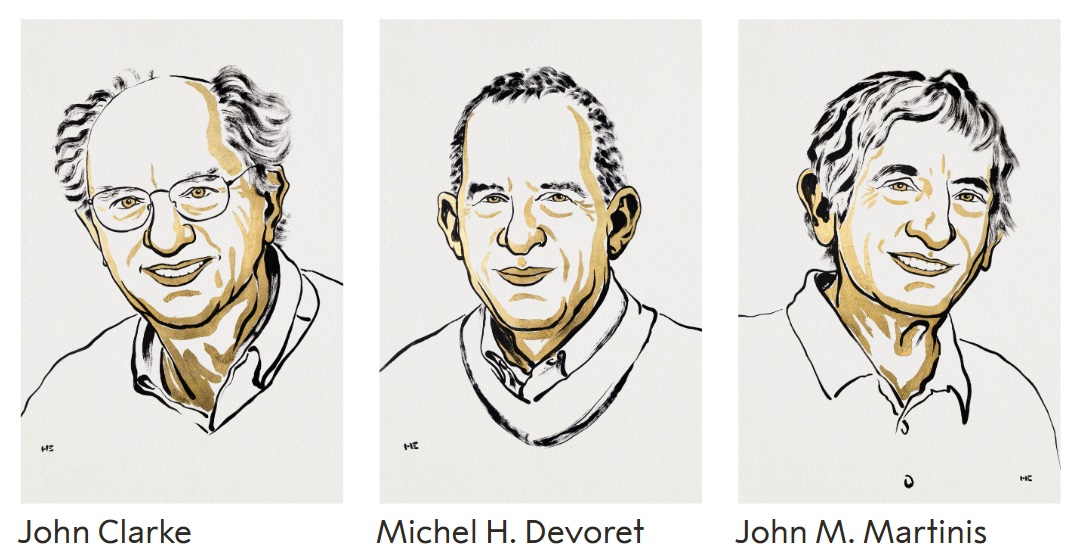
On December 10th John Clarke, Michel Henri Devoret and John Matthew Martinis will receive the Nobel Prize in Physics 2025 for demonstrating quantum phenomena in large electrical circuits. They bridged the understanding of quantum mechanics from individual particles to quantum computers.
Introduction
The Royal Swedish Academy of Sciences has come together to fulfil Alfred Nobel’s will. He stipulated that each year, prizes should be awarded to those who have benefited humanity the most. These awards are given in the fields of Physics, Chemistry, Physiology or Medicine, Literature, Peace, and Economic Sciences.
In this article, I will take a closer look at the Physics prize. This year, almost exactly a century after the birth of modern quantum mechanics1, the prize was awarded to researchers whose work has fundamentally changed our understanding of this branch of physics.
Quantum effects and their uses
In the early 1900s, quantum mechanics was added to the many fields of physics. This paradigm shift gave us a new model to describe a single particle: not as a little ball, but more like a wave. Instead of describing the position of such a little ball, physicists started using the probability that a particle is present at a given point. This probability distribution in space can expand over time, just like water ripples on a lake, and the probability of particles interacting can interfere, both with other particles and with itself, similar to how the wakes of two stones cast into the water behave.
The water analogy of particles like atoms being probability distributions has its limitations. An example is when one observes a particle approaching a barrier that it is not supposed to be able to pass. A water wave would be fully reflected by a barrier, similar to how a dike stops incoming waves from the ocean. In an electrical circuit, for example, this barrier can be a gap between two copper wires. Even though one may expect probability waves to behave like water waves and not cross such gaps, in fact particles can be observed behind it. This phenomenon is called quantum tunnelling. It is less likely to occur when the gap is large. This is famously utilized by a machine called a scanning tunnelling microscope. Unlike optical microscopes, this one has a needle, between which and the material a voltage is applied. If the needle comes close enough to the observed material so that a lot of quantum tunnelling happens, a tiny current starts to run and from it one can determine the distance between the needle and the object. By scanning over the observed object, one can create a 2D image representing the relief of its surface.
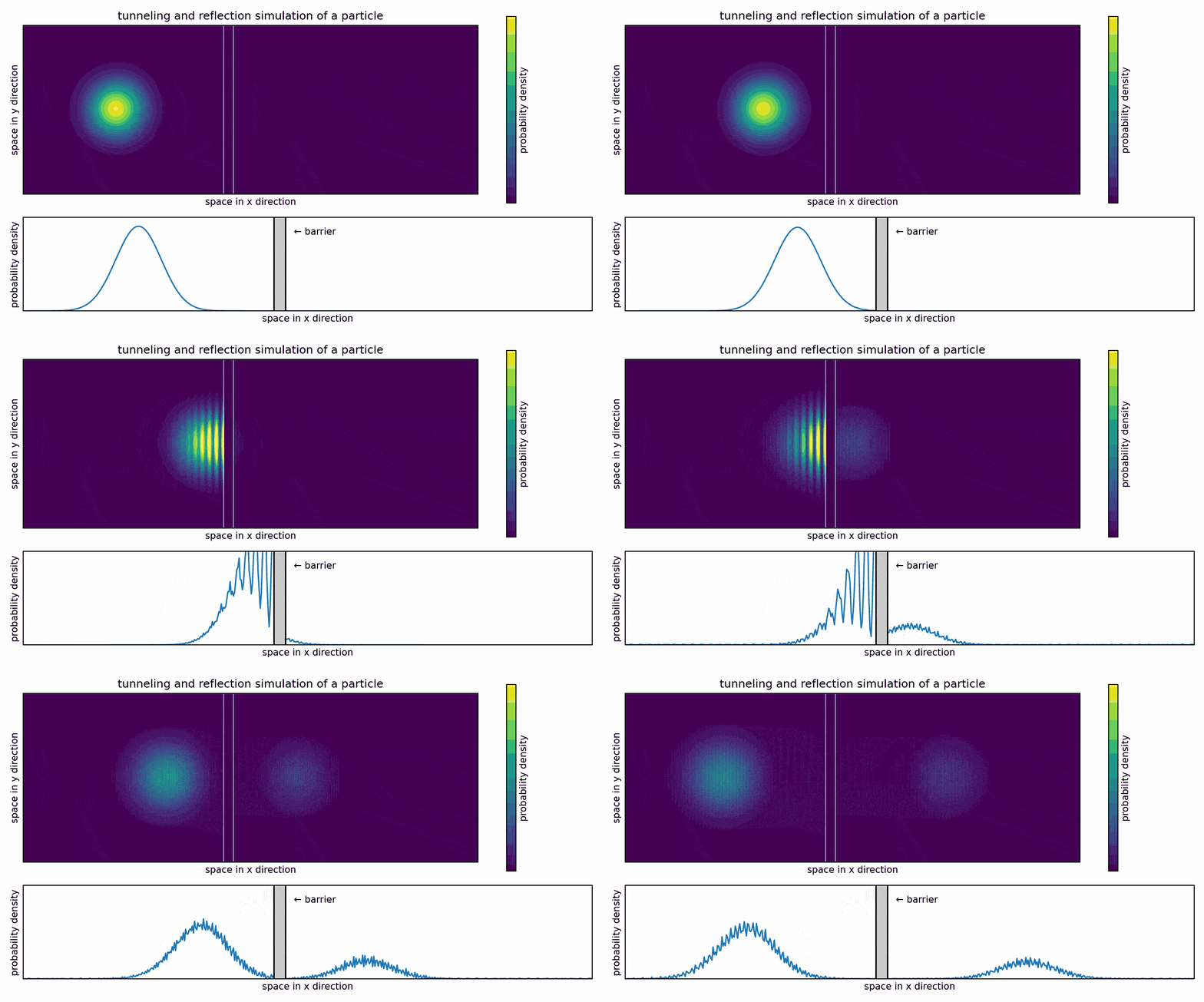
Scanning tunnelling microscopes had already been well studied at the time the Nobel laureates wrote their award-winning paper. The really new thing they discovered was the same behaviour, but for electron currents almost ten orders of magnitude (that is, a factor of ten billion!) larger than that of a single atomic particle.
What have they done?
Clarke, M. H. Devoret, and J. M. Martinis earned their Nobel Prize due to their hard work in the field of quantum mechanics, and in particular for a paper called Measurements of Macroscopic Quantum Tunneling out of the Zero-Voltage State of a Current-Biased Josephson Junction, published in 1985.
I need to start with a couple caveats, because neither “macroscopic” nor “electric circuit” means the same as when I use those terms. First of all, the word “macroscopic” does not refer to the size of the barrier, which was only 2 nanometers large – that’s around 20 atoms next to each other. It refers to the size of the quantum system with which they could observe the tunnelling. The resulting current amounts to a couple of microamps, which sounds tiny, but is possible to measure comfortably in electronics.
Secondly, the electrical circuits mentioned in the title of this article have to be superconducting. A specific material is cooled down to almost absolute zero temperature (around tens of millikelvin). The conducting material in that state does not exert resistance on the electron current: it becomes superconducting. This superconductivity is essential because electrical resistance is the macroscopic behaviour of electrons colliding with the conductor atoms and transferring their momentum. Many interactions between a quantum system and its environment can destroy the state that the electrons have been prepared into. For the macroscopic electron current, this means that any electron bumping into another particle would hinder it from performing its tunnelling.
In the paper, the Nobel laureates describe how they built a Josephson junction. That is an insulator (the barrier) sandwiched between two pieces of a superconductor. At Bell Labs, another group of researchers could show that the superconductors can be prepared in such a way that the resistance of the gap vanishes.
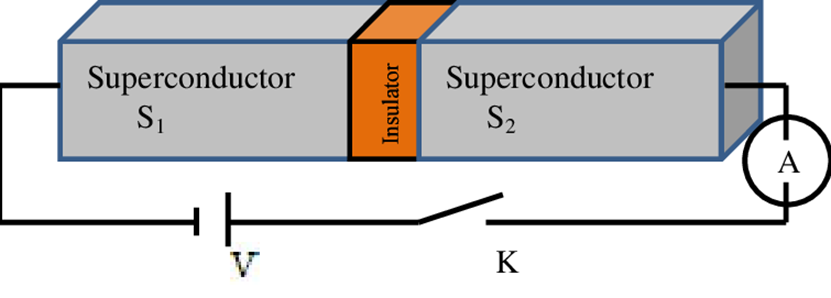
Electrons in a superconductor like to bunch up in pairs with opposite spins, called Cooper pairs. Their existence and tunnelling had already been proven at that time. Under controlled circumstances, Clarke and collaborators were able to observe the entire current tunnelling the gap without interruption of electron flow. The entire electrical circuit behaved in conformity to a single wavefunction. It was a striking demonstration that macroscopic matter can behave as one unified quantum state.
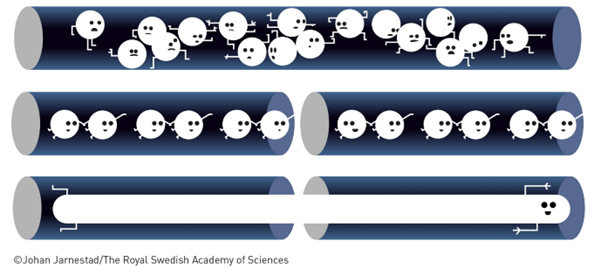
In the paper, the authors used varying electrical currents. This translates into varying energies of the electron stream. They found that the tunnelling rate of the electrons depends on the current, and more importantly, the tunnelling probability scales up discretely. That means that the macroscopic “unit electric current” is an example of a phenomenon that is predicted by quantum mechanics: discrete energy states. The energy difference between those energy states lies in the microwave regime. As a result, an external source of microwaves allows scientists to read out which state the junction is at, or to intentionally excite states. This discovery showed that the principles of quantum mechanics can be shifted into the realms of a microchip.
This is one of the principles that quantum computers are based on nowadays. A single qubit is turned off when there is no current flowing, and is turned on if there is a current flowing. Multiple Josephson junctions can be entangled, which is a fancy word for establishing a correlation between them. This can be done by linking them capacitively or in the way researchers address them with microwaves.
The theoretical foundation of quantum computation had been established five years before the paper of Clarke and collaborators appeared. It was explored most prominently by David Deutsch and Peter Shor. Ten years after the paper the next biggest macroscopic quantum discovery was made: the experimental realization of the Bose-Einstein condensate. This one would get its own Nobel prize in 2001.
Continued Endeavours
Since then, quantum computers have come a long way: now you can log into a machine and control a quantum computer from home. This is something you would have won the Nobel Prize for back in 1985!
After John Clarke wrote the paper with his Ph.D. students Michel H. Devoret and John M. Martinis, all three of them stayed active in the field of quantum physics. John Clarke developed SQUID magnetometers, which became a standard technology for neuroimaging with magnetoencephalography. Both his students have become professors themselves, Devoret pioneering circuit quantum electrodynamics. Martinis researched superconducting qubits and transitioned to research at Google, still working on quantum computing.
The Nobel Prize Lectures and the award ceremony will be live streamed next week – the Physics lectures on 8 December at 9am and the award ceremony on 10 December at 4pm. You can watch the streams (or afterwards: their recordings) here.
Source: https://www.nobelprize.org/prizes/physics/2025/summary/
[1] Usually, the start of quantum mechanics is considered to be Max Planck’s paper from 1900, but in 1925 the theory got its “modern” form when Werner Heisenberg and colleagues described the theory’s mathematical foundations.