
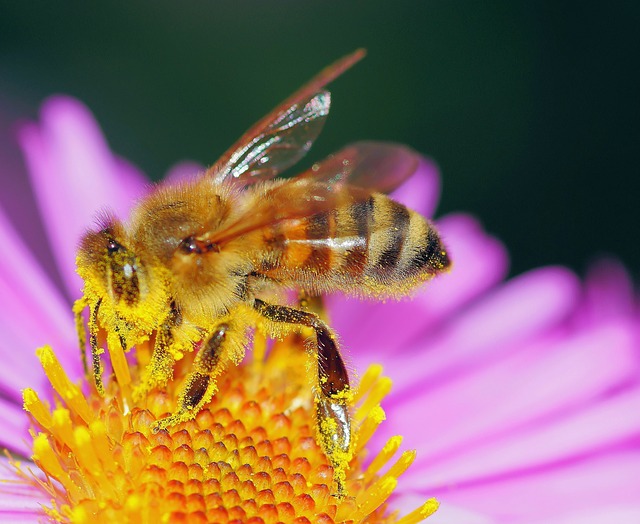
The interactions between bees and flowers depend strongly on sensory signals that the bees receive. This includes visual cues, like a flower’s petal colour and shape, as well as chemical signals, such as scents carried by small molecules in the air. Recent research [Clarke et al 2017] shows that bees moreover use a more surprising sense: the ability to detect weak electric fields. This electroreception plays a role both in communication between bees, and in their interactions with flowers. In this article, I will explain how electric fields arise in the natural world around us, how bees sense them, and why electrostatics plays an important role in the ecology of pollination.
Electric charge in ecology
Electric charges and electric fields arise naturally in the atmosphere, in plants, and even on the bodies of insects. In the following paragraphs, I will explore how the resulting forces build up and behave in the living world. This gives us a clearer view of how flowers and their pollinators have co-evolved to make use of electric forces.
i) The atmosphere
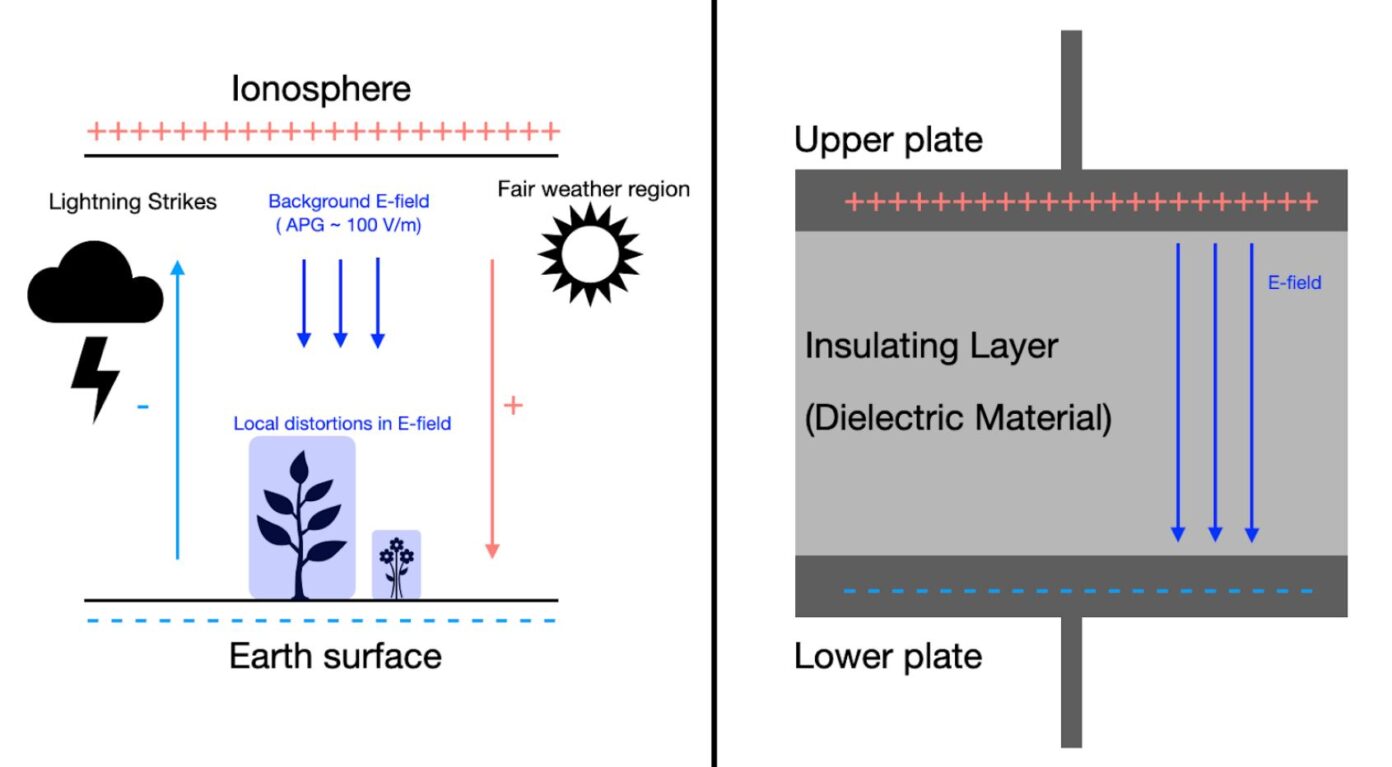
On a global scale, the Earth and its atmosphere together form a system known as the global atmospheric electric circuit, in which electric currents and fields are continuously produced and regulated. One key element of this system is the atmospheric potential gradient, an electric field that stretches from the Earth’s surface to the upper atmosphere [Rycroft 2012].
In fair weather and over flat ground, the electric field above the Earth’s surface increases by about 100 volts for every metre of height. This may sound surprising, as it means that the electric potential difference between your feet and your head is on the order of a few hundred volts, which is comparable to the voltage supplied by a household power outlet. Why, then, is the global electric circuit not dangerous to us humans? A crucial point is that voltages are, by themselves, not harmful to us. However, strong electric currents can dramatically damage the tissues of living organisms, for instance in a lightning strike. Luckily, in fair-weather conditions, the air around us acts as an excellent electrical insulator, thereby preventing any dangerous current from flowing through and harming our bodies. As a result, the global atmospheric electric circuit normally poses no risk to humans, despite the large potential differences involved.
The atmospheric potential reaches its maximum of around 300,000 volts at altitudes of 30–50 km. This potential gradient causes a flow of ions from the positively charged atmosphere to the negatively charged surface of the Earth. This gradient is always maintained because thunderstorms with lightning strikes occur in different places around the globe, pushing charge upward, in the opposite direction to the atmospheric potential gradient. Meanwhile, in fair-weather regions, there is a slow current of charge flowing downward, keeping the global atmospheric electric circuit in balance.
Because the air carries a positive potential, the surface of the Earth ends up slightly negatively charged. This happens through electrostatic induction: negative charges inside the Earth accumulate on its surface to balance the positive electric field above it. You can imagine the Earth as one plate of a large capacitor, with air acting as a dielectric layer, and the high-voltage layers of the upper atmosphere (ionosphere) acting like the opposite plate.
ii) The flowers
Conductive objects that are connected to the ground, such as trees and flowers, also accumulate negative charge on their surfaces. The amount and distribution of this charge depend strongly on the height and shape of the object. Some regions gather charge more easily than others, creating localised electric forces that distort the otherwise uniform atmospheric electric field.
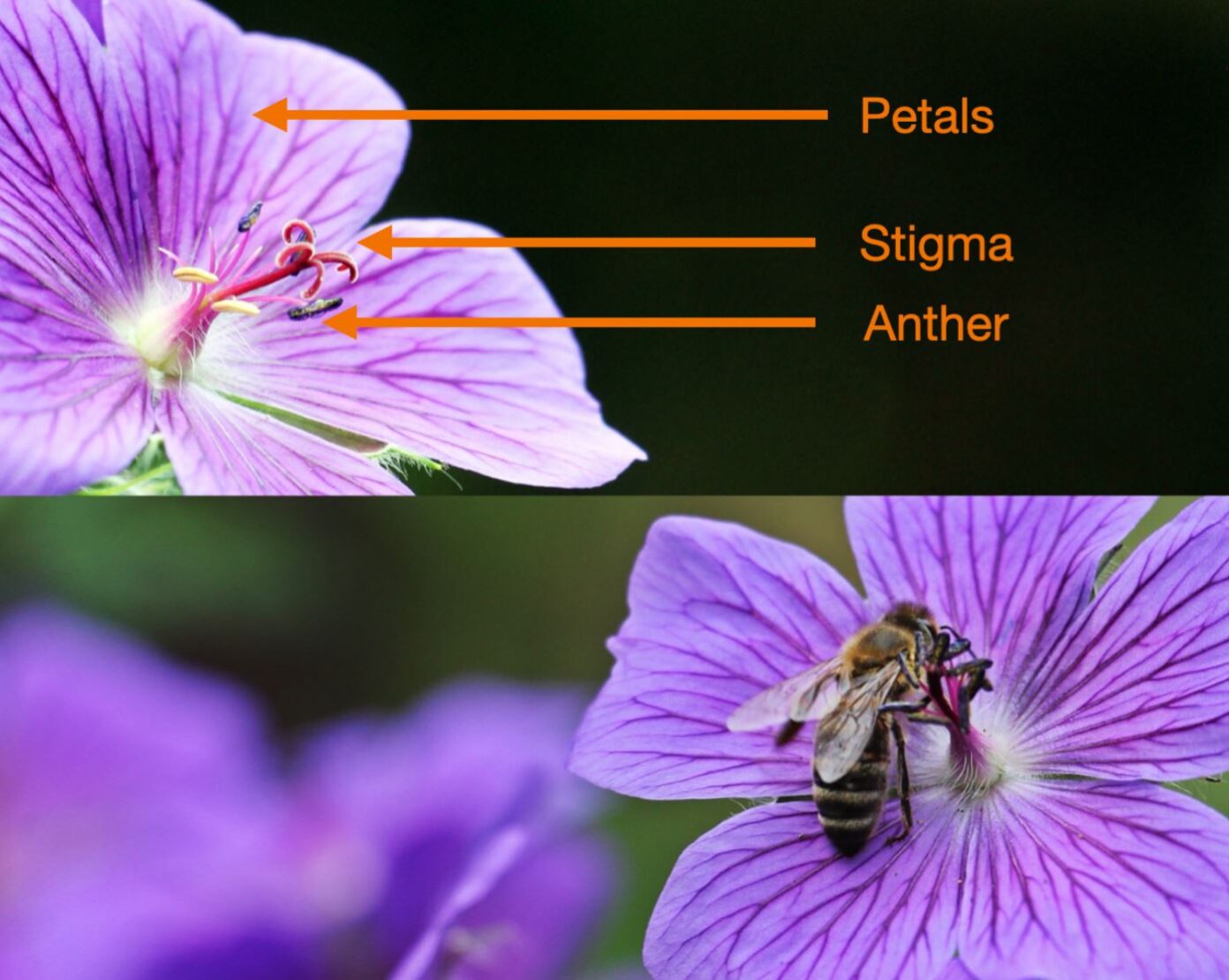
In particular, charge tends to build up more strongly on sharp, protruding, or highly curved features. Examples include the reproductive organs of a flower, which are shown in Figure 2. The anthers are the male reproductive organs that produce and release pollen. The female reproductive organ, named stigma, often has a rough or sticky surface that helps catch pollen to enable fertilisation. Such protruding features of plants act in a similar way to lightning rods: they are tall, pointed, grounded objects that concentrate electric charge and strongly distort electric fields around them.
Consequently, flat or gently curved surfaces like leaves or petals hold less charge, whereas edges, petal tips, or the anthers and stigma tend to accumulate more. Because each flowering species has its own geometry and anatomical structure, it produces a unique “electrostatic floral footprint”. [Clarke et al. 2017] This is a characteristic electric field pattern surrounding the plant. Bees can detect and use these patterns to tell different flowers apart and even to recognise different parts of a single flower.
iii) The bees
Bees are not grounded to the Earth when they fly, so they do not accumulate negative charge like plants do. Instead, they become positively charged through the so-called triboelectric effect. In general, this phenomenon occurs when two materials rub against each other and electrons are transferred, leaving one surface more positively charged, and the other one more negatively charged, than before. In fact, you have probably noticed the triboelectric effect before, when you rubbed a rubber balloon against your hair and it stuck due to static electricity.
The triboelectric effect similarly affects most insects: the hard outer layer of their bodies often becomes positively charged after friction with different materials. [Clarke et al 2017] Thus, while a bee flies through the air, or lands on flowers, it tends to lose electrons as its wings and body brush against tiny particles or plant surfaces. This is why bees will eventually carry a net positive charge on the surface of their body.
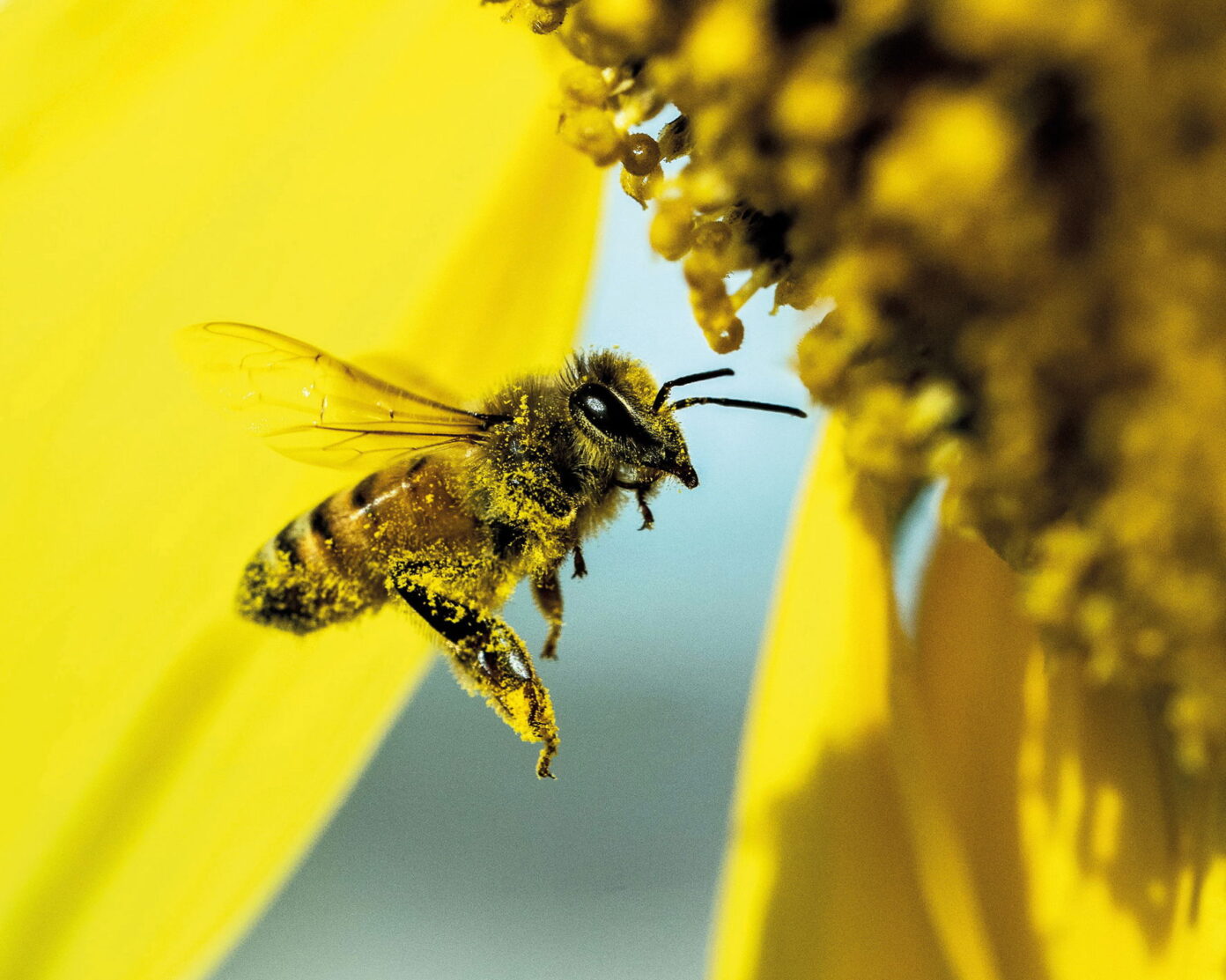
A positively charged bee approaching a negatively charged flower will therefore experience an electric interaction. This interaction is helpful during foraging, because it makes pollen stick to the bee more easily. In figures 3 and 4, you can clearly see pollen accumulating on the bee’s outer surface, particularly on pointed body parts such as the legs, hairs, and antennae. It also produces tiny electric forces on specialised sensory structures on the bee’s body. These forces are central to electroreception, the ability of an organism to detect external electric fields and use them to gather information about its environment.
Electroreception: how bees detect and use weak electric fields
i) Mechanosensory hairs
In bees and bumblebees, electric field detection relies on mechanosensory hairs. These tiny hairs can bend when exposed to an external electric force. When a hair deflects, it activates a nerve cell at its base, sending information to the bee’s nervous system. This is similar in principle to how a cat uses its whiskers to detect touch or air currents, except that bees’ hairs respond to electric rather than mechanical forces. With these hairs, bees can sense the strength and direction of electric fields around them.
It is important to note that not all of the hairs covering a bee’s body act as sensory receptors. Most of a bee’s “fur” serves other functions, such as collecting pollen, as illustrated in Figures 3 and 4. Only a small subset of hairs function as mechanosensory receptors. These specialised hairs are found predominantly on the head and antennae, and on parts of the body that are most exposed to the surrounding electric field, such as the thorax. [Sutton et al. 2016] Thus, bees are somewhat comparable to cats: they have dense fur for insulation and protection, as well as specialised whiskers that help them sense and navigate their environment. The key difference is that cats’ whiskers respond to direct mechanical contact or air movements, whereas a bee’s mechanosensory hairs are sensitive to electric forces.
In air, electric fields around plants weaken quickly with distance, so bees can detect them only when they are relatively close to the source, typically within a few to around ten centimetres. At distances of just about two to three bee body lengths, the electric field between a bee and a flower can reach up to 5 kilovolts per metre, a strength comparable to the field beneath a high-voltage power line. This is enough to make the bees’ mechanosensory hairs respond clearly, thus transmitting information about the surrounding electric fields to the bee’s nervous system.
Electric cues sensed through the mechanosensory hairs help bees navigate their surroundings with greater precision. They can use differences in field strength and direction to distinguish objects with different shapes and sizes, identify specific parts of a flower like the stigma or anthers, and judge which flowers are likely to provide nectar or pollen. In this way, electrostatic information supports their foraging behaviour by improving spatial orientation and helping them choose the most rewarding food sources.
ii) Electrostatics and pollen transfer
Electric fields do even more than merely guide bees towards flowers. They also help pollen move efficiently, which makes pollination more successful. A pollen grain suspended in the air is influenced by three main forces: gravity, which pulls it downward; viscous drag from the surrounding air, which slows its motion; and electric forces, which depend on the charge and polarity of the pollen and nearby objects.
Because pollen grains are extremely small and light, gravity has very little influence on them. Thus, electric forces can dominate the way they move. As a result, charged pollen grains can easily “jump” from a flower to a bee, or from a bee to a flower, if there is an electric field.. Studies show that pollen mostly follows curved trajectories shaped by these electric forces, eventually landing on the bee’s hairs or on the flower’s reproductive organs. This improves the efficiency of pollination by reducing the amount of pollen lost to the ground. In practice, this means that pollen is guided toward the parts of the flower where it is most likely to contribute to successful fertilisation, as well as easily “sticking” to bees. This effect is clearly visible in images showing pollen dust accumulated on the bees’ hairs and the protruding structures of flowers.
iii) Communication between bees
Electroreception is not only useful during foraging, where it helps bees sense features of their surroundings. Bees also use it to communicate after returning from a foraging trip. In particular, honeybees perform a “waggle dance” to signal the distance and direction of good food sources to other members of the hive. Because a dancing bee is electrically charged, its movements create tiny oscillating electric fields. Other bees can detect these signals with their antennae, effectively allowing them to use electric cues to talk to each other [Greggers et al. 2013].
Conclusions
The familiar sight of a bee settling onto a flower is influenced by far more than just colour, shape, or scent. There is an entire layer of electrostatic signalling at work that we cannot typically see. Electric fields help steer pollen from one surface to another, they influence a bee’s choice of which flower to visit next, and they contribute to the “conversations” that take place back in the hive. This hidden electrical language, and the way it ties together physics and biology, offers a fresh perspective on one of nature’s most important partnerships: flowering plants and the bees that pollinate them.
References
[Clarke et al. 2017] Clarke D, Morley E, Robert D. The bee, the flower, and the electric field: electric ecology and aerial electroreception. Journal of Comparative Physiology A. 2017 Sep;203(9):737-48.
[Rycroft 2012] Rycroft MJ, Nicoll KA, Aplin KL, Harrison RG. Recent advances in global electric circuit coupling between the space environment and the troposphere. Journal of Atmospheric and Solar-Terrestrial Physics. 2012 Dec 1;90:198-211.
[Sutton et al. 2016] Sutton GP, Clarke D, Morley EL, Robert D. Mechanosensory hairs in bumblebees (Bombus terrestris) detect weak electric fields. Proceedings of the National Academy of Sciences. 2016 Jun 28;113(26):7261-5.
[Greggers et al. 2013] Greggers U, Koch G, Schmidt V, Dürr A, Floriou-Servou A, Piepenbrock D, Göpfert MC, Menzel R. Reception and learning of electric fields in bees. Proceedings of the Royal Society B: Biological Sciences. 2013 May 22;280(1759):20130528.