

In the first article of this series, I started with the theme of thinking-in-space and talked about why it feels intuitive, and in doing so developed a modern definition of geometry. To summarize, I said a geometry is defined by a set of transformations, and notions of a geometry are exactly those which remain meaningful after performing its defining transformations. For example, Euclidean geometry was the one associated with rigid transformations: rotations, translations, reflections. These transformations preserve lengths and angles. Not coincidentally, these notions were the ones used by ancient Greeks to describe regularities of physical space: a square remains a square in ordinary 3-dimensional space after applying any or a combination of the mentioned transformations.
Since a square remains a square after rigid transformations, that is, it preserves its identity of “squareness,” we also called such transformations symmetries of the square – and the same holds for any Euclidean geometric object. Crucially, I also distinguished two types of “sameness”: the type that preserves a square, and the one that preserves the square. The distinction was: to preserve “a square”, the object should map onto the same object, including its location within space. On the other hand, preserving “the square” had to do with preserving the governing rule of being a square, that is, excluding its location and looking at whether it satisfies the conditions of being a square. For example, we saw that if one rotates a square by 360 degrees, the transformed square would be identical to the untransformed square; if one performs a scaling transformation, the transformed square would have different side lengths while retaining the conditions for being a square; and in contrast to these examples, if one places a Euclidean square on a sphere, its defining characteristic about right angles would not be preserved – the Euclidean notion of a “straight line” doesn’t have a direct counterpart on a sphere.
The problem can be intuitively understood by considering a property of Euclidean geometry: a Euclidean space is defined through rigid transformations that preserve distances; hence any two parallel straight lines always have a fixed distance between them. For a sphere, two lines which start as parallel at the equator necessarily meet at the poles. Thus, on a sphere it is not possible to talk about Euclidean parallelism and construct squares made up of four right angles. The angles will in fact always be larger than right angles, depending on the relative size of the square to the sphere.
In the last article, I also started talking about how concepts of geometry and symmetry relate to physics. I first said physics is a practice that concerns organizing observations of natural phenomena, then pointed out that to organize, or identify, natural phenomena one asks the question, “what does identifying mean?” The answer to this question naturally came in terms of symmetry: an object, or observation, is identified through the ways it remains the same. We did not yet see how this understanding concretely finds its use in physics, or in the task of organizing natural phenomena, but we already saw how it becomes useful in a toy model: the example of identifying a square or equivalently organizing Euclidean geometric objects. In this article, we will carry the experience we gained in the last article and, as promised, talk about the geometry of nature. I said “geometry” but by now you may notice that I use the words geometry, symmetry and transformation quite synonymously: geometry of physical space, symmetries of physical laws, and transformations in physical space are all closely related.
Symmetries and physical laws
Physics is an empirical science – it is based on observations – and its overarching goal is to obtain descriptions of natural phenomena. Hopefully, this ultimately even leads to obtaining a unified description of all phenomena guided by a singular organizing principle. As we have seen, symmetry seems to have the power to be such an organizing principle. Let us now reconsider the example of the square, but this time in a more physical way regarding the observations we can make about such an object. Last time, I followed a more mathematical approach: I mentioned a capability of “choosing” a set of transformations and followed the consequences of the choice. Fundamental physics does not lend us this option1 and at best what we can do is try to make sense of our observations.
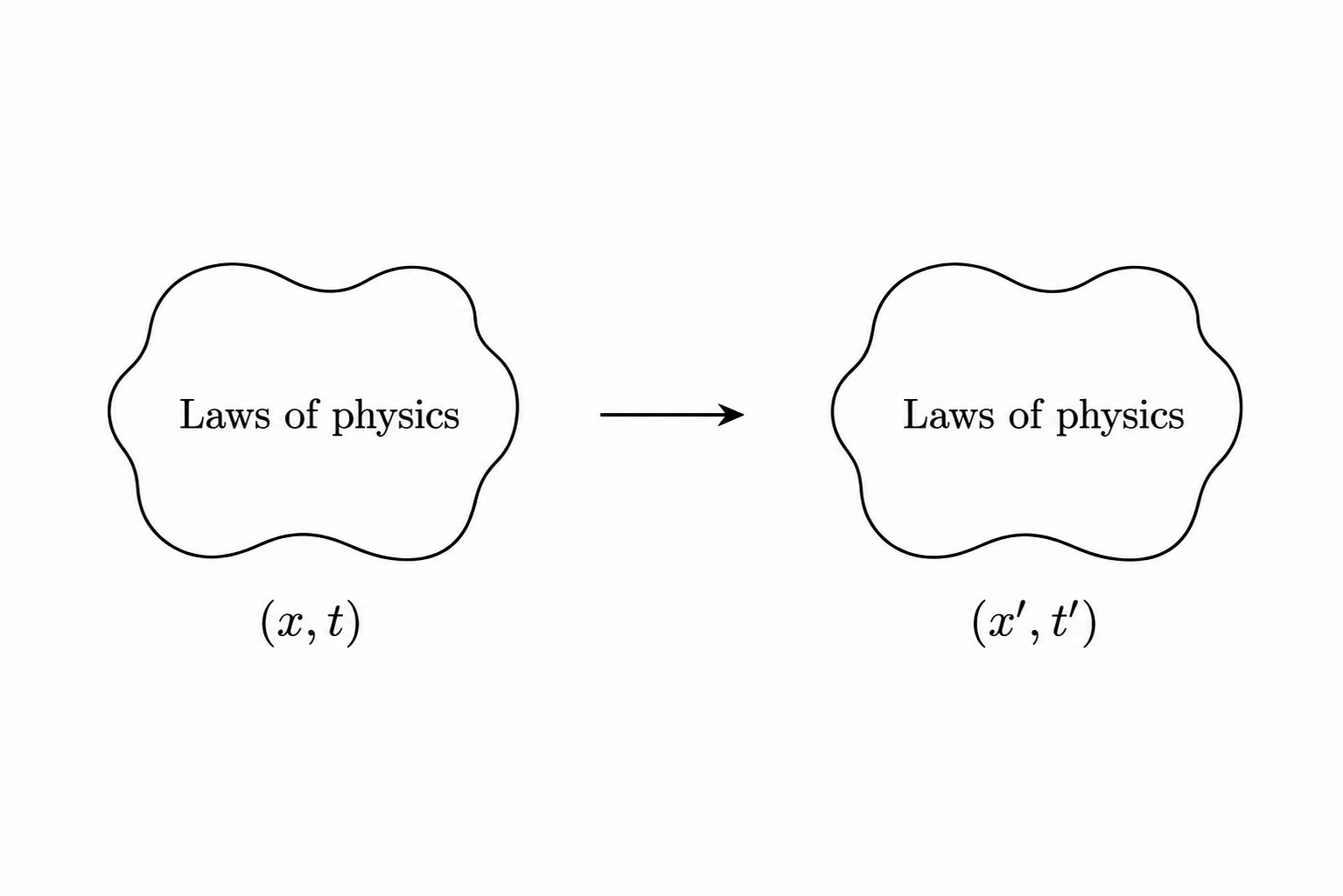
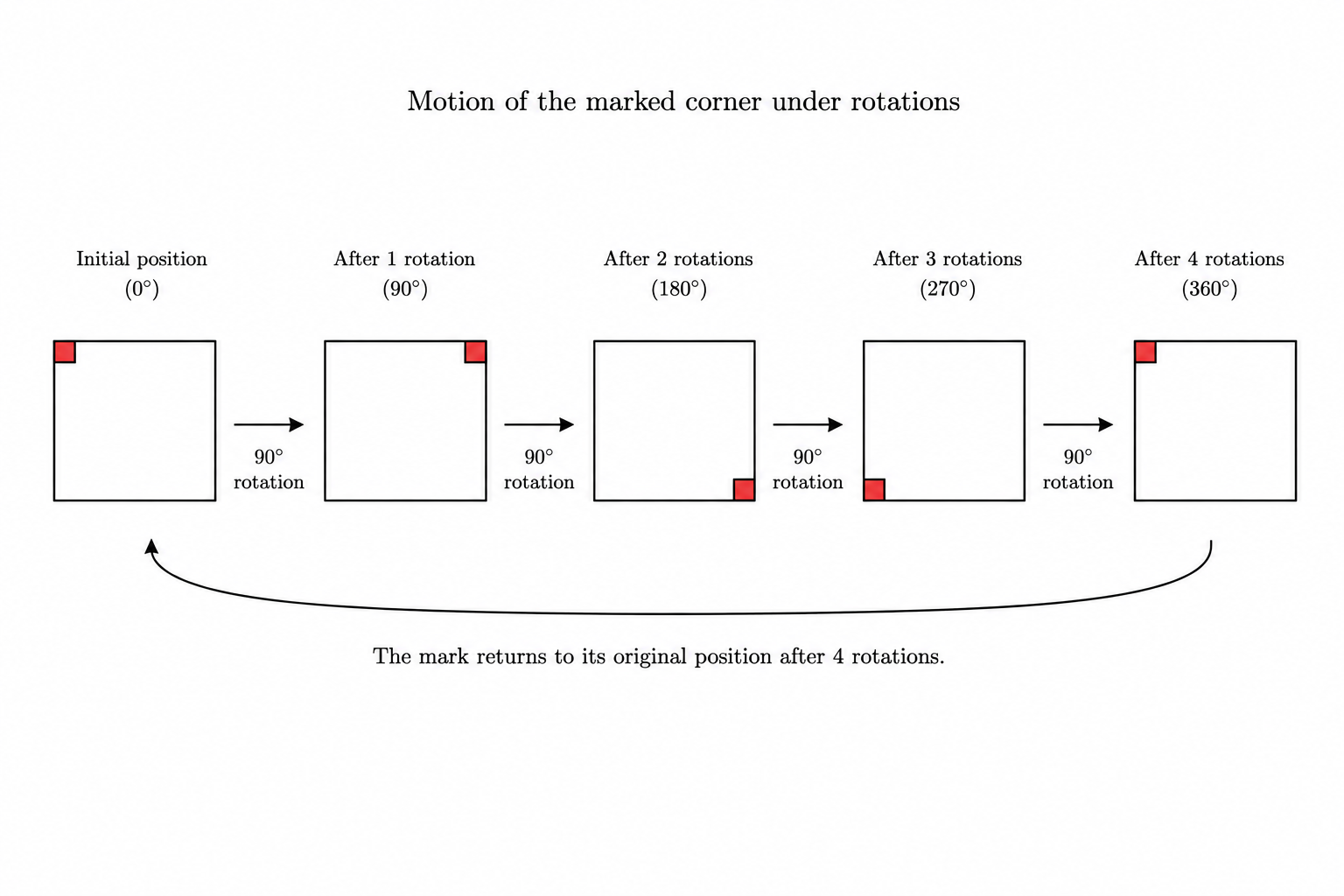
One such physical observation is that we identify a square-shaped object as the same regardless of physical location, directional orientation, or time instance it may be in. We identify it as “the same” not just because it looks the same but because it behaves in the same way- it responds identically when subjected to the same physical conditions. The object will behave identically today here and tomorrow there. If we define the way it behaves as a “physical law,” this means that the physical laws themselves are symmetrical in space and time; see figure 2. So no point in space or moment in time is privileged, and in the eyes of nature all are of the exact same character. This blindness of nature is a symmetry of it – just like how the square looks the same to you following a rotation. This symmetry of physical laws thus belongs to the second category of sameness I talked about. In comparison, if you were to mark a point on a square and rotate the square by 90 degrees, you would see the mark is now at a different corner: you chose a privileged point on the square (or space) and distinguished it from the rest. This “symmetry-breaking” action of marking belongs to the first type of sameness and for a square to look the same upon rotation you would need to rotate it by exactly 0 degrees, 360 degrees, 720 degrees, or any other integer multiple of 360 degrees (figure 3). In the context of physical laws, nature does not “mark” points in space or time and treats all the same. A slight caveat: the configuration of the object that realizes the physical law can then break the symmetry of the law in a similar way as it should choose a position or orientation to be an instance of it; but the law would apply the same had the object “chosen” a different position or orientation. This phenomenon, in which a system’s configuration has fewer symmetries than the law governing it, is known to physicists as “spontaneous symmetry breaking”.
Symmetries of space and time
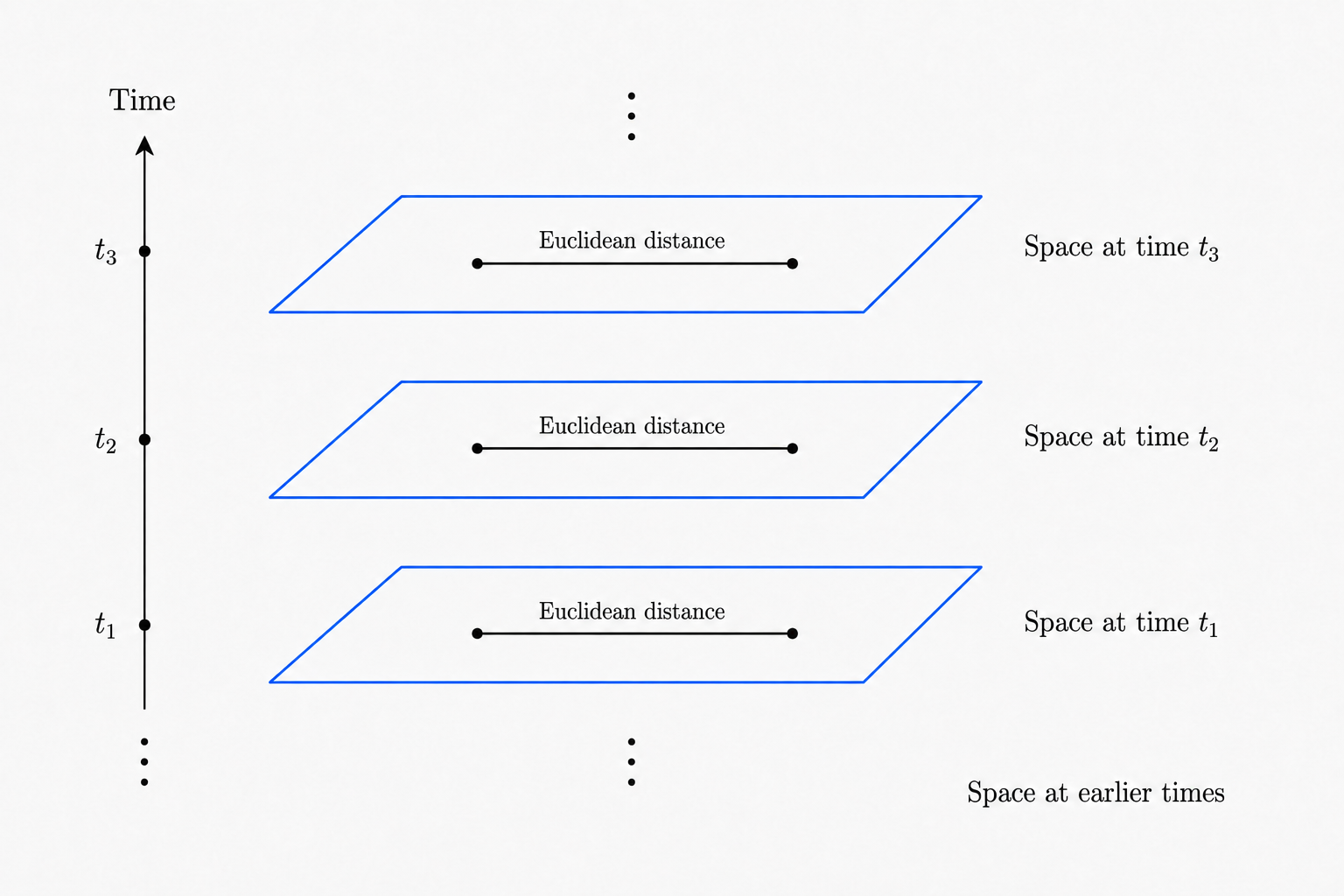
So, what are some symmetries of nature? I have mentioned rotation, translation and reflection in physical space2 as some of those. These rigid transformations are exactly the ones that characterize Euclidean geometry. This is also why it was the first geometry to be discovered; it is intuitive. However, if we want to talk about physical laws, we must also include time translations. Today and tomorrow are the same from the point of view of physics. We can combine rigid transformations with time translation and say Euclidean geometry is true at all instances of time. In other words, if you freeze the time at one moment and be left only with 3-dimensional space, nature’s geometry looks Euclidean; but since we also have time translations, it must be the same Euclidean geometry at every frozen instant alike (figure 4).
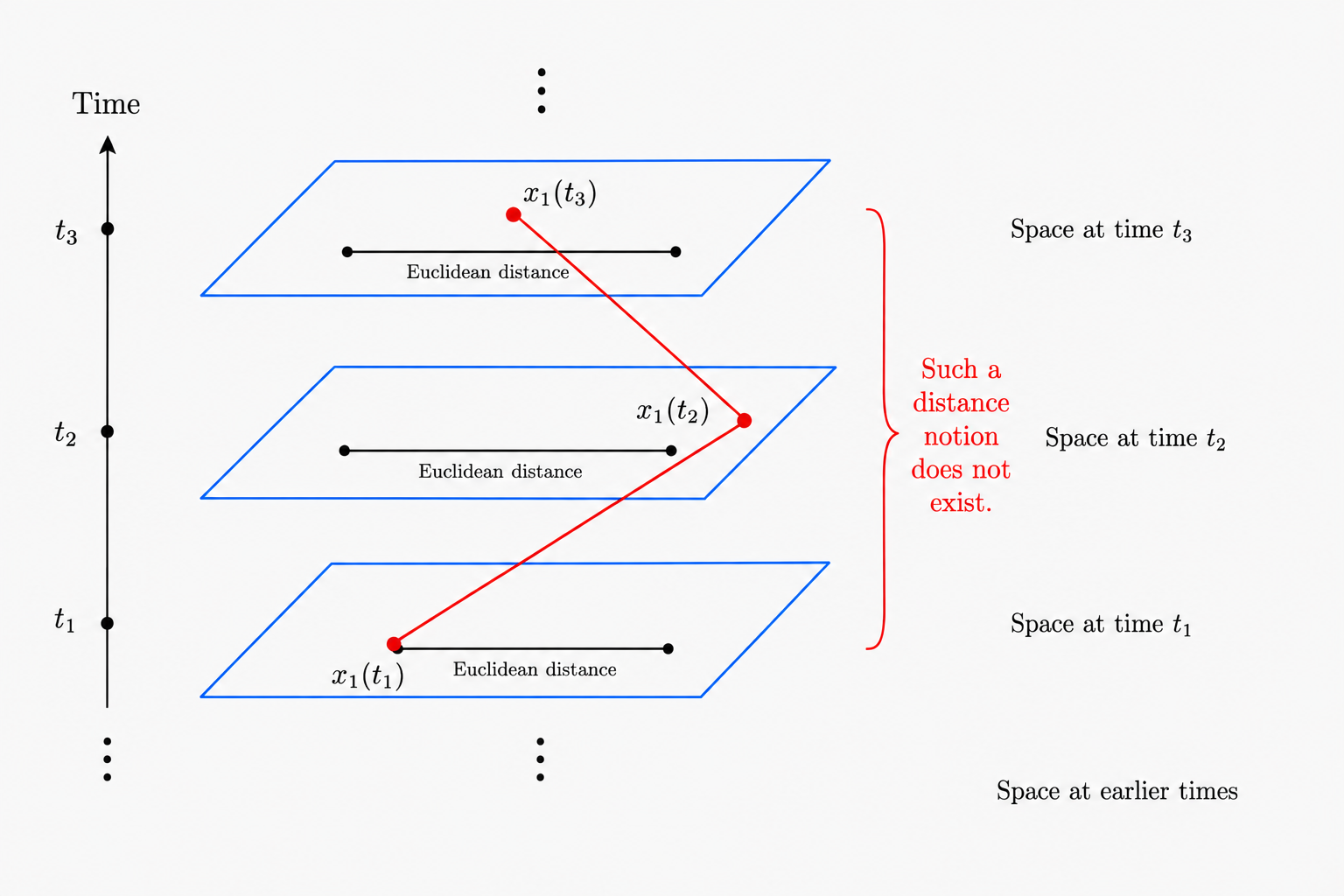
Together with time translation, the combined set of transformations (rigid motion + time translation) define a new geometry where no point in space or time is privileged. Its meaningful notions are differences in position and differences in time. These are the only physically meaningful measurements we can make: there is no notion of absolute position or absolute time. This also implies everyone will agree on measurements regarding distances between two spatial points at an instant of time (Euclidean distance) and differences in time (how much time has passed between two instants). So, the world is pictured as a kind of box that includes all instants of time – see figure 4. There is another implication: Euclidean geometry of space only applies at an instant of time and not across two instants. Thus, within this worldview the geometry is fragmented. What I mean by this is that locations considered at different times cannot be compared: “same place different time” has no meaning – see figure 5. Time differences are meaningful only because time is thought to exist independent of three-dimensional space and everyone with a clock, no matter where they are in space, would agree on “now” and “5 minutes later.”
Symmetry of motion
From our daily experience, we also know there is another symmetry in nature: boost symmetry. The name may not be familiar, but having this symmetry essentially means that absolute velocities do not exist – there is no experiment that can measure how fast you are going. Only velocity differences exist. To some people, this idea is very intuitive, for others it is not. Consider the following: if you were to sit in a windowless car, would you be able to know your speed and direction? If the car has constant velocity, and drives over a completely smooth road, the answer is no. Moving at any constant velocity relative to someone standing in the street or being at rest relative to someone standing in the street literally feels the same. We can use this observation and say: similar to not distinguishing a location or moment of time, physical laws also do not distinguish absolute velocities. It is not a meaningful notion within nature’s geometry.
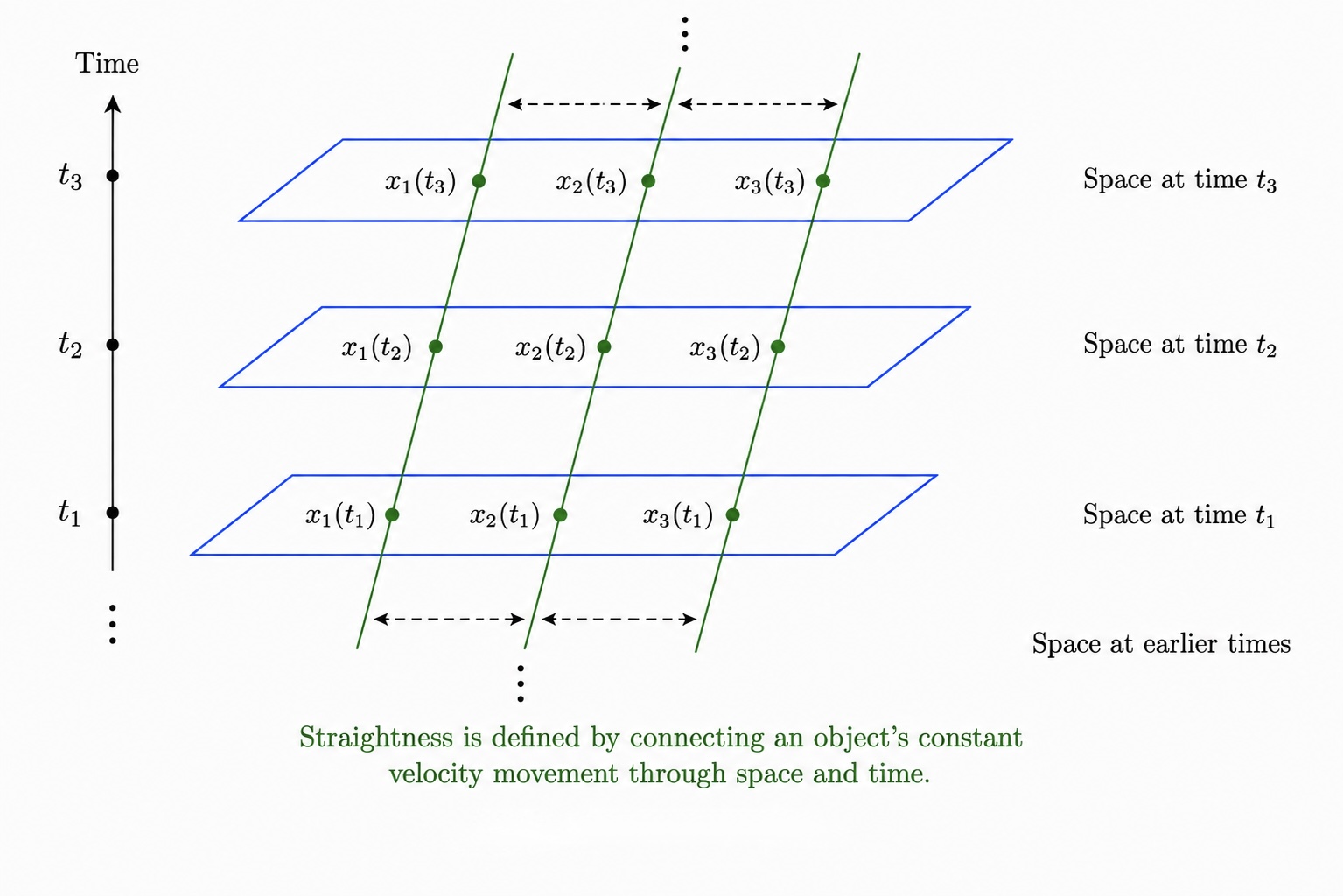
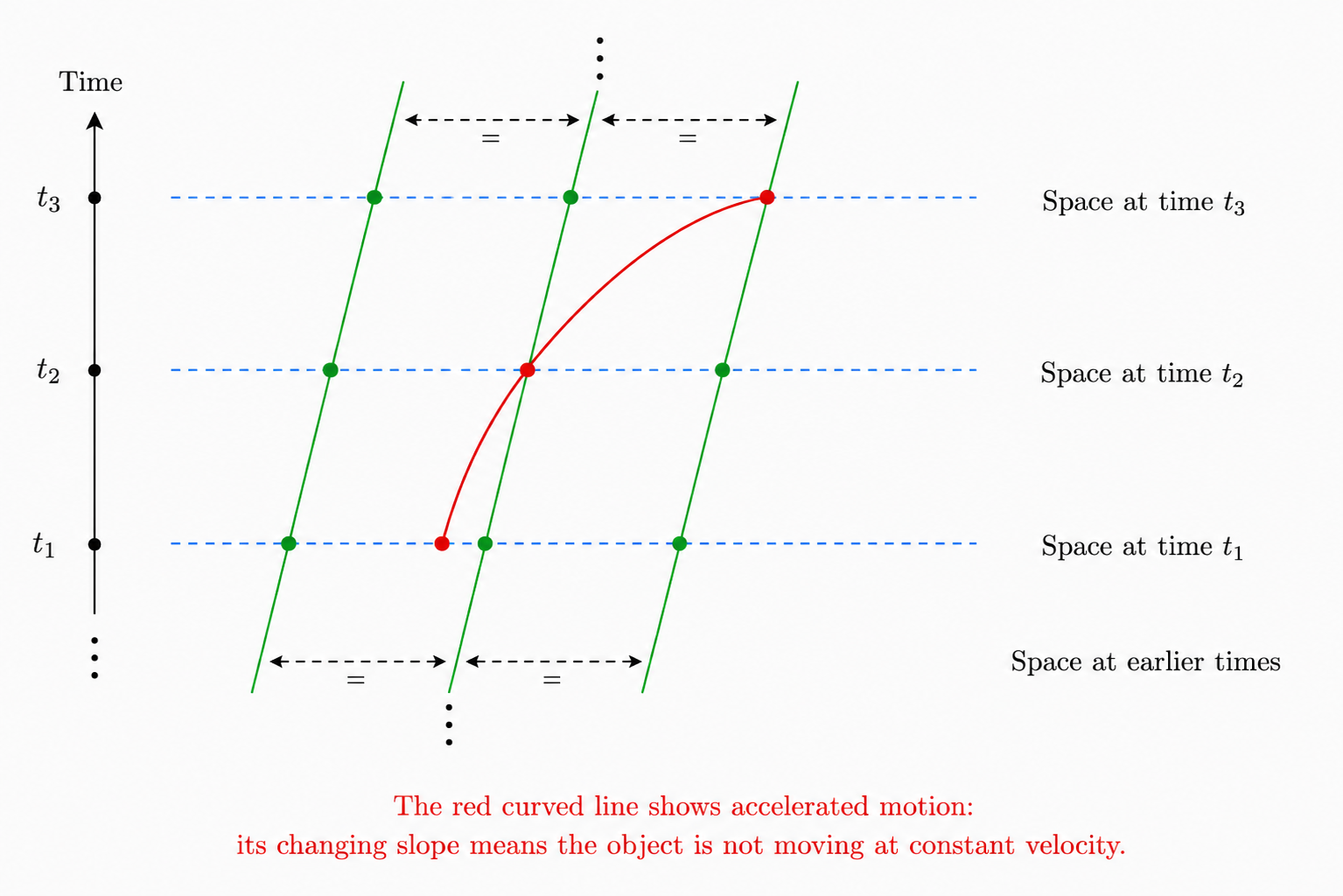
One thing we can distinguish or measure is acceleration: even in a windowless car, you would know if the car suddenly stopped or sped up. You would feel a “force” pushing you opposite to the direction of that acceleration. (As a side note: to a physicist, “slowing down” is also acceleration: the direction of acceleration compared to the direction of motion does not matter.) The fact that such a force is experienced, and that it only depends on acceleration, implies that nature apparently admits a notion of absolute acceleration. But how can we measure absolute acceleration? There must be a reference, or since we are talking about motion, a “distinguished motion,” which we can use for comparison. As this distinguished motion, we can choose the motion that any non-accelerating object moves with. Since we are again talking about a comparison, let me also note that this type of comparison is different than the one I mentioned in the relative-velocity argument. Here we do not need a specific reference object, such as the person standing on the street, instead the reference is a whole class of motions that serves as a universal reference for all objects. More geometrically, we can consider non-accelerated motion as a notion of “straightness” for motion – see figure 6. Since time and space are fragmented in this worldview, and the concept of motion involves a movement in both time and space, non-accelerated motion essentially defines what is considered “straight” across time and space. In this sense, acceleration becomes a measure of deviation from that straightness – see figure 7.
From symmetries to physical laws
Let us now reconsider all these different observations about symmetries to see what they tell us about physical laws. In the last few paragraphs, I explained that our observations of nature tell us that physical laws should be symmetric with respect to spatial rotations, spatial translations, spatial reflections3, temporal translations and boost transformations. In summary, this means no absolute direction, no absolute position, no absolute time and no absolute speed exist in nature; only differences of each quantity matter. At the scale we are considering, nature does not distinguish any direction, position, moment in time, or velocity. From the previous article, we also know that these observations, listed as a set of transformations under which nature stays “the same”, fix a geometry for space and time combined. We saw that conversely, an absolute and measurable quantity is acceleration, measured and defined with respect to a distinguished type of motion: inertial motion.
Let me list these statements again, in a different order, as three postulates: (i) there exists a distinguished type of motion, of non-accelerating objects; (ii) accelerated objects experience a type of force and the force cannot depend on absolute quantities like spatial position, spatial direction of the original motion, or velocity; (iii) when an object is accelerated, the force associated with the acceleration acts back in the opposite direction. Perhaps, you may notice that these statements look familiar. These postulates are known as “Newton’s laws of motion,” and we arrived at them purely by investigating the symmetries of nature. In other words, we fixed what physical laws must look like by assuming a geometrical structure for nature, derived from a number of symmetries.
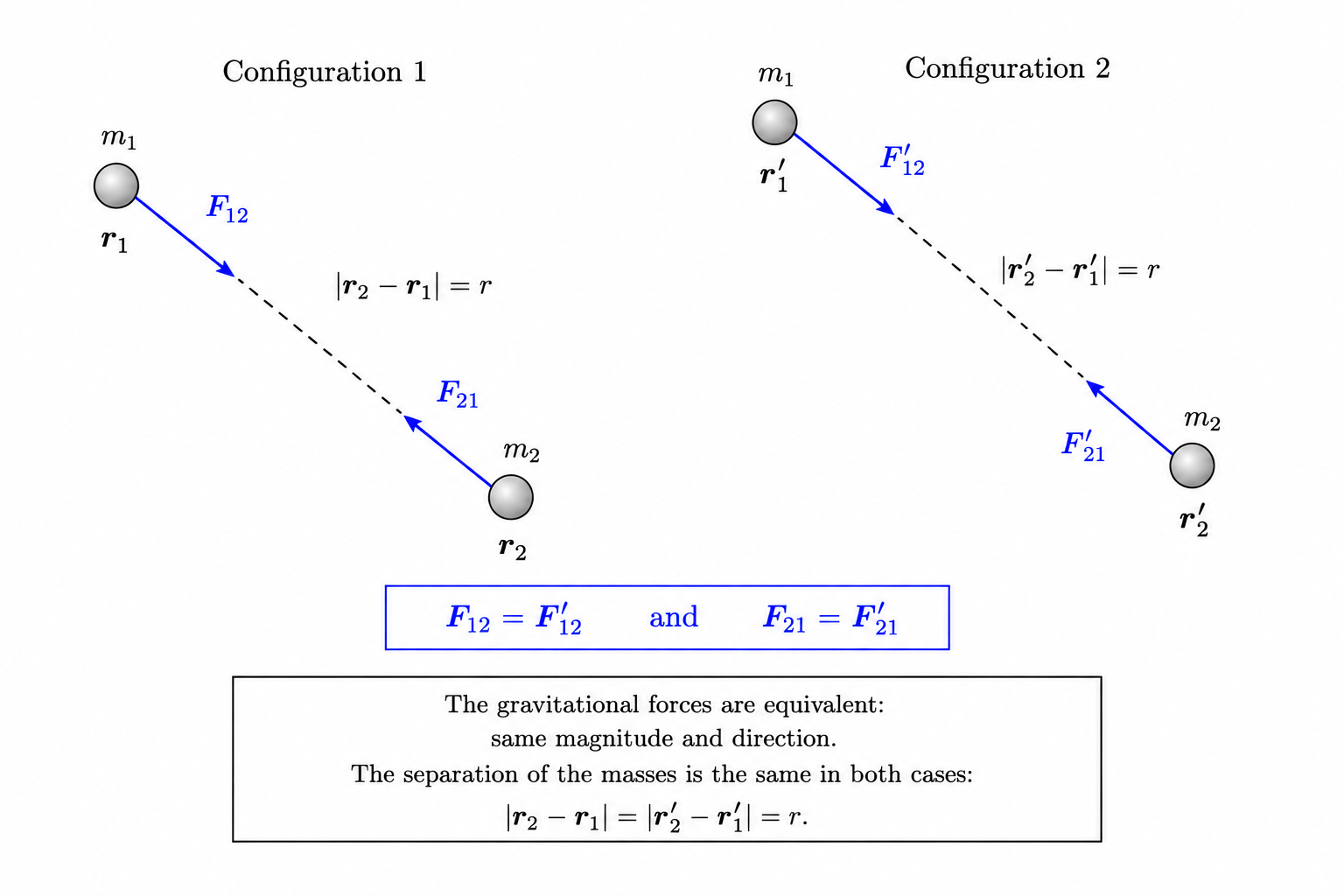
In Newtonian terms, the first law reads: “a body left by itself stays at rest or traces a straight line with constant velocity.” This is what I called a distinguished motion, or inertial motion, and said the collection of all such motions is identical for all objects which fixes a notion of “straightness” in space and time. The second law reads: “acceleration of a body is proportional to a force” and in mathematical symbols traditionally written as F=ma. This law captures my statement that acceleration, as a deviation from distinguished, inertial, “straight,” motion, is associated with a force. In the expression a number “m” also shows up, and it experimentally determines how “hard” it is to make an object deviate from that “straight,” distinguished motion. Typically, we call the quantity that determines this inertia the “mass.” As I stated, also the form of the force that shows up in the left-hand side of the expression is fixed: when two objects A and B interact and one exerts a force on the other, the force can only depend on the relative position and velocity of the objects. Such a force term is generally called a “Newtonian force.” This mathematical structure of the force is a result of the geometry we assumed in our description and indeed observed in nature as such. A famous example of such a Newtonian force is Newtonian gravity (see figure 8):
\( \large \vec{F} \propto \frac{\vec{r_1}-\vec{r_2}}{|\vec{r_1}-\vec{r_2}|^3} \).
Notice that indeed the gravitational force only depends on relative direction and relative distance between two objects and absolute quantities do not show up. Finally, Newton’s third law reads: “every force has an equal and opposite reaction.” This corresponds to the observation that inside an accelerating car, you feel yourself pushed into your chair, in a direction opposite to the direction of acceleration.
A crack in the picture
From the discussion so far, we see that choosing a set of transformations, that is, a geometry, for physical space and time almost entirely fixes the shape of physical laws of motion. The remaining ingredients to arrive at specific laws are numbers which correspond to measurable quantities, like mass. However, as residents of the 21st century we know that Newton’s laws are not always consistent with observations. Famously, these laws of motion are inconsistent with the theoretical prediction and experimental fact that the speed of light is a finite constant of nature. Thus, we can now turn our reasoning around: these inconsistencies with observation must mean that we have started from the “wrong” geometry! During our assumptions for symmetries of nature, we must have made a mistake somewhere when relating velocities. In particular, our boost transformation which relates velocities seems to contain an error. In the next instalment of this series, we will look at how this issue is resolved, what it implies for laws of physics, and therefore what this means for the geometry of space and time.
[1] The physical laws themselves need not depend on human observers. However, physics, as a human practice, involves choices concerning the mathematical frameworks through which we understand and describe physical phenomena. So, one may still make the argument that we always have the option to choose a convenient description guided by pragmatics and instruments.
[2] Some processes in particle physics are not reflection symmetric. The weak interaction – one of the four fundamental forces – treats left and right differently: it acts only on “left-handed” particles (or “right-handed” anti-particles) in its charged interactions. In particle physics, this asymmetry is known as “parity violation”.
[3] As I mentioned in the previous footnote, reflection is not an exact symmetry of nature and some processes in particle physics violate this symmetry. However, I included this symmetry in this list as it is still respected at the scale we are considering within this text.
Alle artikelen in deze serie:
- From symmetry to geometry
- A first look at the symmetries of nature