
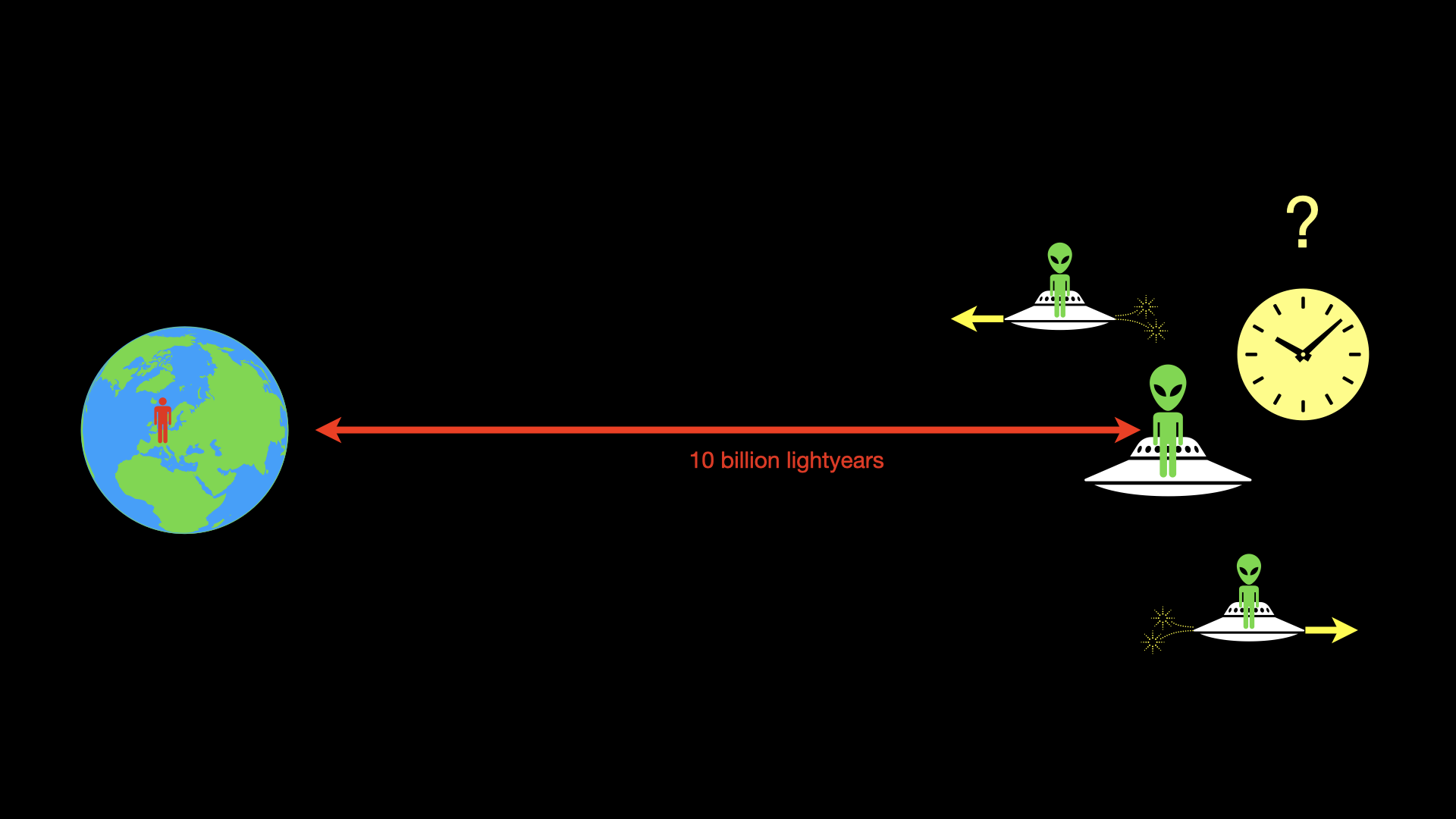
In this article, I would like to answer an intriguing question from one of our readers, Arno. While reading Brian Greene’s The Fabric of the Cosmos (2004, pp. 129–142), Arno came across a thought experiment related to Einstein’s theory of special relativity and wondered how such a seemingly bizarre situation could make sense.
In the passage in question, Greene describes a situation involving two far separated observers, at rest with respect to one another. (In this thought experiment, we neglect any motions of surrounding planets, galaxies, and the expansion of space.) One of the observers, let us say: you, is located on Earth, whereas the other one, an alien, is in their spaceship 10 billion light years away, in the depths of space.
As long as both observers do not move with respect to one another, they share the same reference frame. This implies that their clocks tick at the same rate and they share a common “now”. By this, I mean that both of them agree on which events happen simultaneously.
Things, however, become much stranger once the alien’s spaceship begins to move relative to you, even if it does so at a very low speed. Once the observers are in relative motion, they no longer share the same reference frame. One implication of this is that their clocks no longer tick at exactly the same rate. As a consequence, they also no longer agree on which distant events are happening right now. Physicists call this the relativity of simultaneity.
In this thought experiment, there are two possibilities: the alien can either move away from Earth, or they can move towards it. According to special relativity, these two situations lead to different definitions of what counts as the alien’s present moment. If the alien moves away from Earth, it turns out – as we will see in detail below – that events that the alien considers to be happening “now” lie further in your past. (This differs from the earlier situation in which you and the alien were at rest relative to one another, so your respective definitions of “now” coincided.) If, on the other hand, the alien moves towards Earth, the situation reverses. Events that the alien regards as occurring “now” happen simultaneously to events that lie in your future. In other words, the alien’s present then corresponds to events that, from your perspective, have not happened yet.
At first sight, this seems absurd: How could a slight change in motion of the alien’s spaceship possibly alter what counts as the present moment on a planet billions of light-years away? Yet this surprising conclusion follows directly from one of the central postulates of Einstein’s theory: the speed of light is the same for all observers, regardless of how they move. To preserve this fundamental fact, it turns out that space and time must adjust in ways that defy our everyday intuition, causing different observers to disagree about simultaneity.
In this sense, the question raised by Arno touches upon one of the deepest mysteries in modern physics: does time truly flow from past to future, as we experience it? Or are past, present, and future equally real but observer-dependent notions? In the remainder of this article, we will explore how Einstein’s theory leads to this fascinating debate.
Newton’s classical mechanics versus Einstein’s theory of relativity
At first sight, the situation of our two distant observers seems straightforward. As long as neither the Earth observer (you), nor the alien move relative to the other, both agree on what is happening “right now” in the Universe1. Their clocks tick at the same rate and they share the same notion of the present.
This view is perfectly consistent with Newton’s classical physics, according to which space and time are separate and absolute quantities. Space acts as a vast cosmic stage on which events unfold, while time flows uniformly forward. No matter where observers are located or how they move, everyone agrees on what belongs to the past, the present, and the future.
Einstein’s special theory of relativity fundamentally changed this picture. To be precise: Newton’s theory remains an excellent approximation for everyday situations, but relativistic effects become noticeable when velocities approach the speed of light, often denoted by c. Under such extreme conditions, our intuitive notions of space and time begin to break down.
One of the most surprising consequences of Einstein’s theory is the aforementioned relativity of simultaneity. I.e., observers moving relative to one another do not necessarily agree on which events occur at the same moment. What one observer considers to be happening “right now” may belong to another observer’s past or future.
You might have encountered this counterintuitive idea in the context of the ladder-and-barn paradox. Imagine a super-fast farmer carrying an extremely long ladder and running towards a barn at nearly the speed of light. The ladder is so long that, when at rest, it cannot fit inside the barn with both doors closed simultaneously.
However, according to special relativity, an object moving at high speed appears shorter along the direction of motion. This phenomenon is known as Lorentz contraction. To a stationary observer standing beside the barn, e.g., a curious cow, the moving ladder appears contracted and briefly fits entirely inside the barn. From the cow’s perspective, both barn doors can therefore briefly be closed at the same time, enclosing the ladder. To the farmer, however, the situation looks completely different. In the farmer’s frame of reference, it is the barn that is moving and therefore appears length-contracted. Thus, the barn seems even shorter than before, making it seemingly impossible for the ladder to fit inside.
This apparent paradox arises because the farmer and the cow do not agree on what it means for two events to occur simultaneously. In the cow’s frame, the front and back doors of the barn close at exactly the same moment, briefly trapping the entire ladder inside. However, in the farmer’s frame, the two doors do not close simultaneously. The front door closes and reopens before the ladder reaches it. Only later does the rear door close as the back end of the ladder passes through the barn.
Although the two observers disagree about the timing of the door closures, they agree on all observable outcomes: the ladder passes safely through the barn without breaking any doors. The paradox disappears once we recognise that simultaneity itself depends on the observer’s reference frame. A more detailed explanation of this paradox and its resolution, including spacetime diagrams, can be found in this previous article by Marcel Vonk.
Such spacetime diagrams (also discussed here) represent both space and time in a single graph. The horizontal axis corresponds to position, while the vertical axis represents time, for convenience often rescaled and written as ct, where c is the speed of light. Multiplying time by the speed of light ensures that space and time are measured in the same units and can be represented on equal footing. This is essentially what we do when measuring distances in, e.g., light years, the distance travelled by light in one Earth year.
In such a spacetime diagram, a stationary observer uses an ordinary rectangular grid. An observer moving at relativistic speed uses a tilted grid. The faster the relative motion, the greater this tilt becomes.
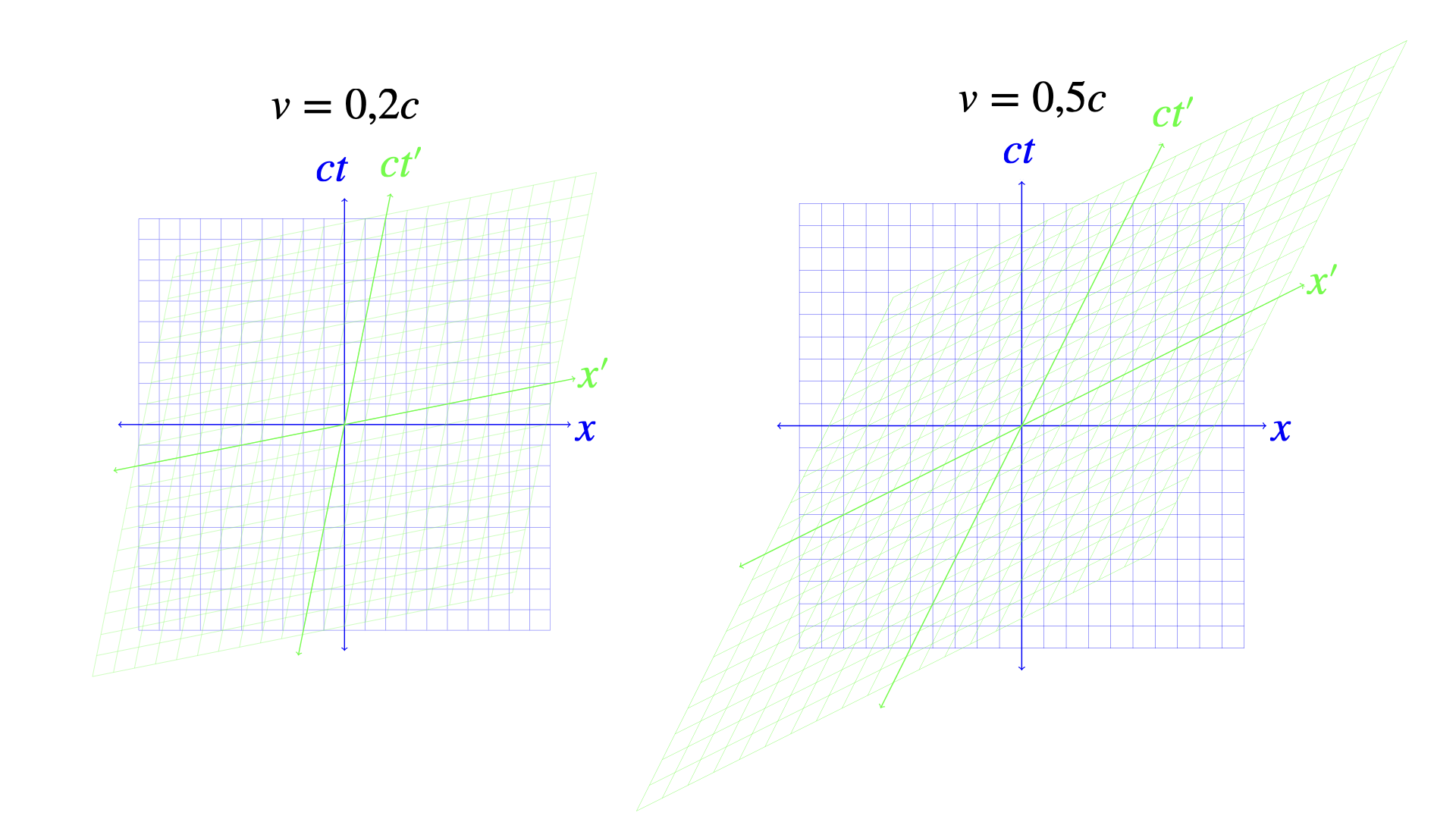
A simple but very relevant remark is now: events that occur simultaneously for a given observer lie along a line of constant time – in fact, this is simply the definition of what we mean by “simultaneous”. Thus, for our current discussion, these lines of constant time are the most important feature of the spacetime diagrams. For a stationary observer (blue), these lines are horizontal. For a moving observer (green), they are tilted. As a result, two observers moving relative to one another literally slice spacetime into “past”, “present”, and “future” in different ways.
Note how Einstein’s view of spacetime is very different from Newton’s: in a “Newtonian spacetime diagram”, the green grid would be a sheared one, where only the vertical axis (the moving observer’s “here”) would get tilted as they move through space. However, the horizontal axis (the moving observer’s “now”) would remain perfectly horizontal and aligned with that of a stationary observer, implying that they share the same present (represented by horizontal “now” lines). In this sense, Einstein’s view is much more symmetric than Newton’s: space and time are intertwined, and changing one’s motion affects both in the same way. It is precisely this geometric structure that ensures that every observer measures the same speed of light. (Note that light always travels along 45° lines in spacetime diagrams.)
The above diagrams thus visualise the relativity of simultaneity in a geometric way. At everyday speeds, the tilting effect on the green axes is extraordinarily small. Your definition of “now” is thus practically identical to that of everyone around you, which is why Newton’s picture works so well in daily life. However, when either distances become enormous or velocities approach the speed of light, the effect can no longer be ignored.
Back to Greene’s thought experiment
In the previous section, we saw that special relativity replaces Newton’s absolute notion of space and time with a more subtle picture. Different observers can disagree about which distant events occur simultaneously, depending on their state of motion. To help visualise this idea, Brian Greene uses the analogy of a loaf of bread in The Fabric of the Cosmos. See the video below2:
Rather than using the full three-dimensional picture, in this article, we shall analyse Greene’s thought experiment using spacetime diagrams, which are essentially a lower-dimensional representation of the same idea. Instead of describing three dimensions of space and one dimension of time, we consider only a single spatial direction, labelled x, together with time, labelled t or its rescaled version, ct. Although simplified, this lower-dimensional picture still captures all the essential physics needed for our discussion.
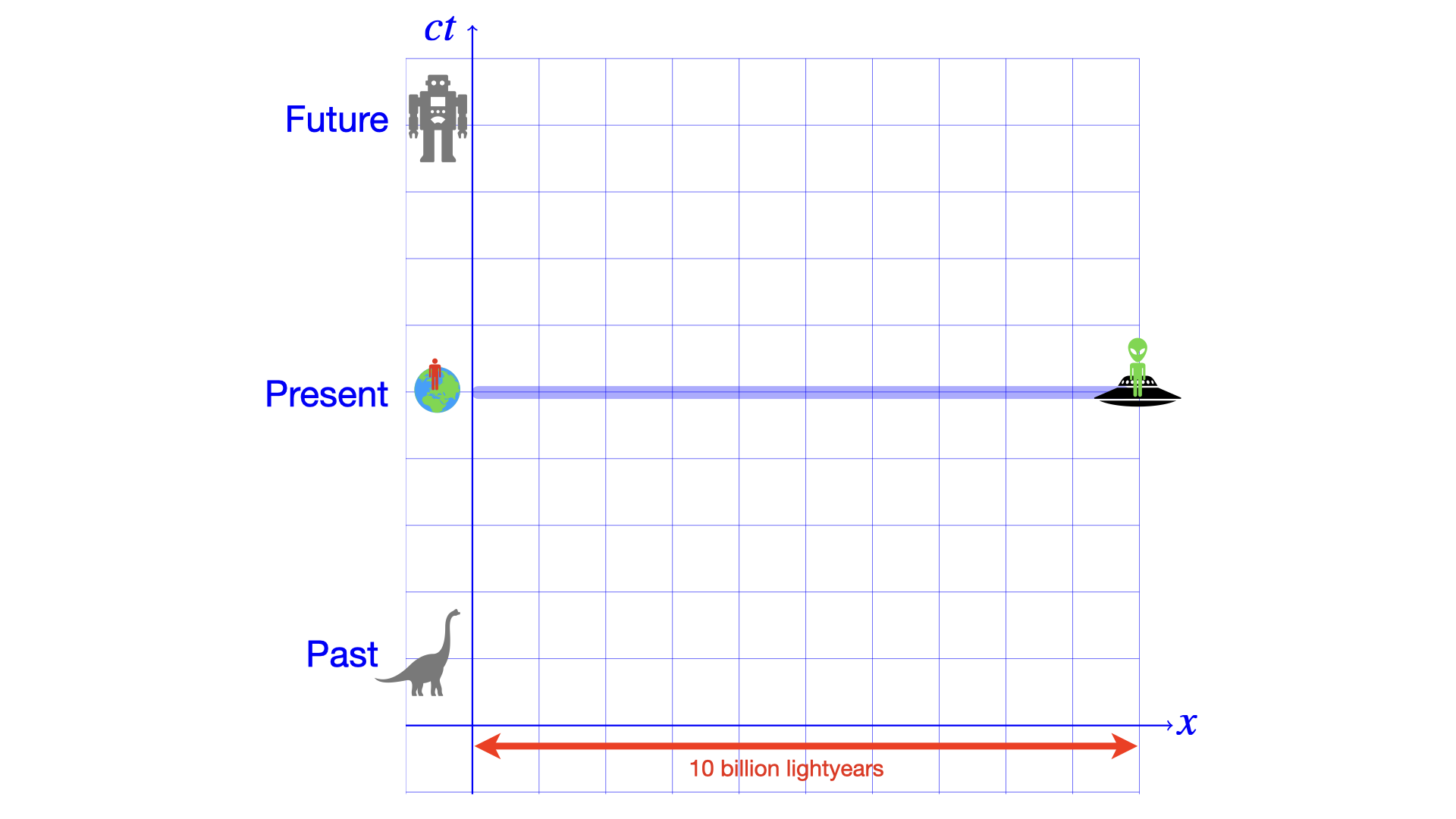
Let us first consider the situation where you (on Earth) and the alien are separated by 10 billion lightyears (an enormous distance!) and are at rest relative to one another. As illustrated in figure 2 below, spacetime is represented by the blue coordinate grid for both stationary observers. Each horizontal line represents an observer’s definition of “now”, i.e. all events lying on such a line are considered simultaneous. In this case, both you and the alien agree on this “now-slicing”.
A second observer moving relative to the first uses a different coordinate grid, shown in green in the previous diagrams. As we saw in the previous section, observers moving at relativistic speeds do not agree on simultaneity with stationary observers. Consequently, their lines of constant time are tilted with respect to the blue ones. Events that are simultaneous for one observer are generally not simultaneous for the other.
However, the situation described by Greene seems puzzling, since the alien spaceship is moving relative to Earth at only a few kilometres per hour. How could such a tiny speed have any noticeable relativistic consequences? The answer lies in the enormous distance separating both observers. In a spacetime diagram, relative velocity determines the angle between the two coordinate grids. At low speeds, this angle (e.g. between the blue x and green x’ axes) is extremely small. If the observers are relatively close together, the resulting difference in simultaneity is thus negligible, as shown in figure 3.
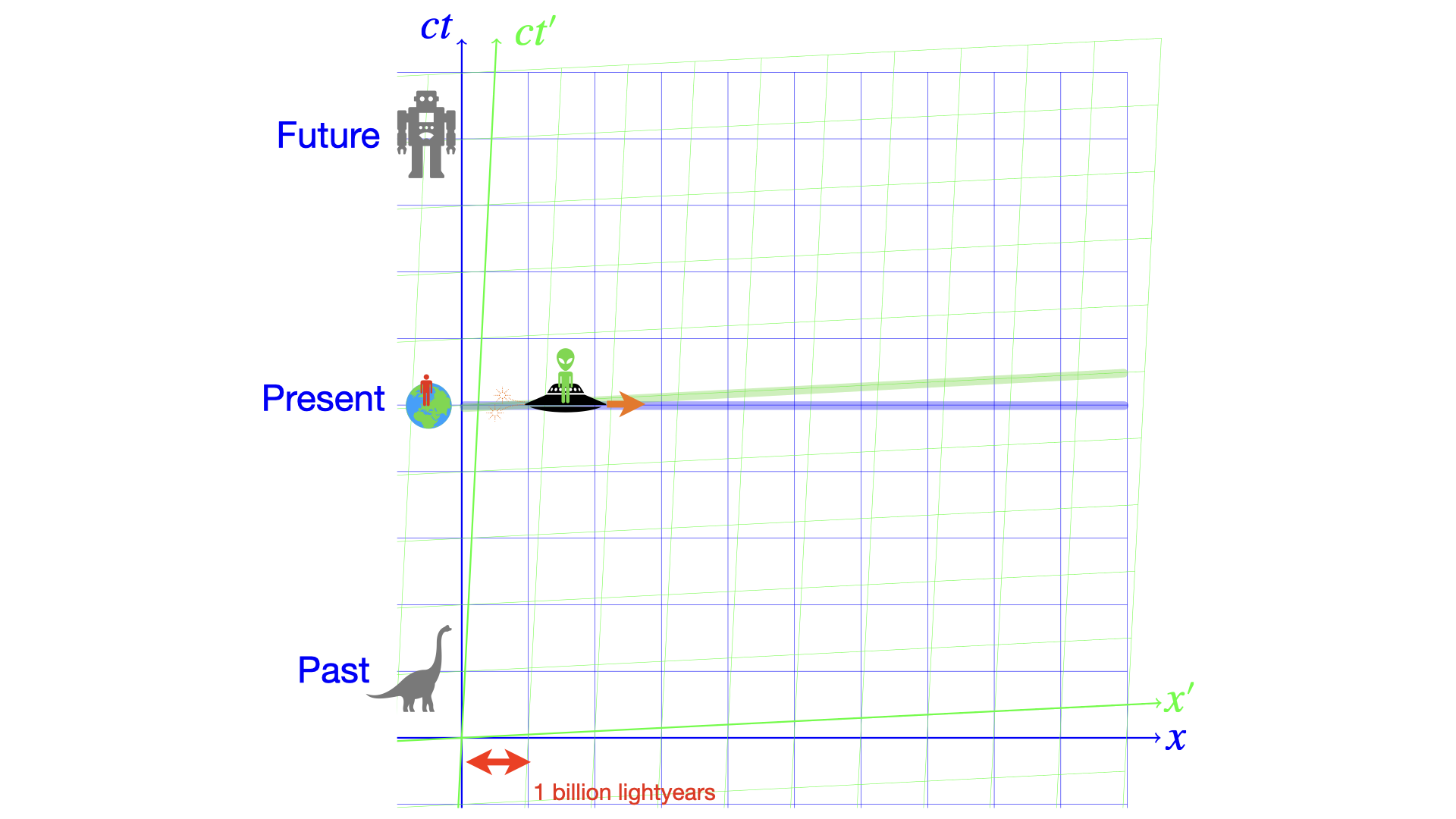
However, Greene’s thought experiment involves a separation of roughly 10 billion light-years. Over such immense distances, even a tiny angular difference can dramatically shift which events are regarded as simultaneous. Suppose the alien begins moving relative to Earth at approximately 15 km/h. Although this speed is insignificant compared to the speed of light, the enormous distance between Earth and the alien amplifies the effect of the rotated axes. Using the equations of special relativity, one finds that the alien’s definition of “now on Earth” shifts by roughly 150 years relative to ours3. If the alien moves away from Earth, events that occurred around 150 years ago may lie on the alien’s present slice of spacetime. This is visualised in figure 4.
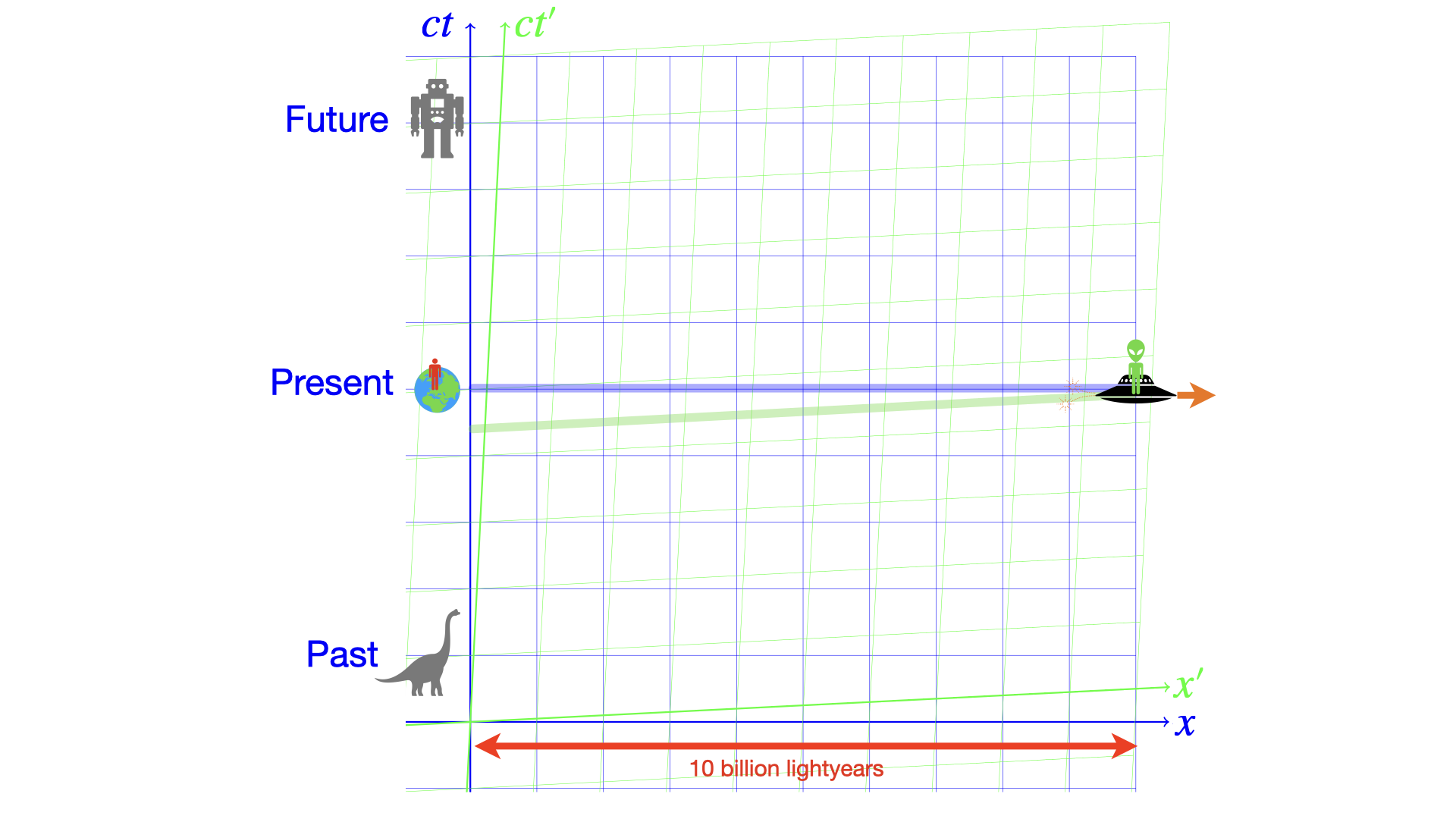
If the alien instead moves towards Earth at the same speed of 15 km/h, the shift occurs in the opposite direction. Events that we regard as taking place roughly 150 years in your future could belong to the alien’s present – see figure 5.
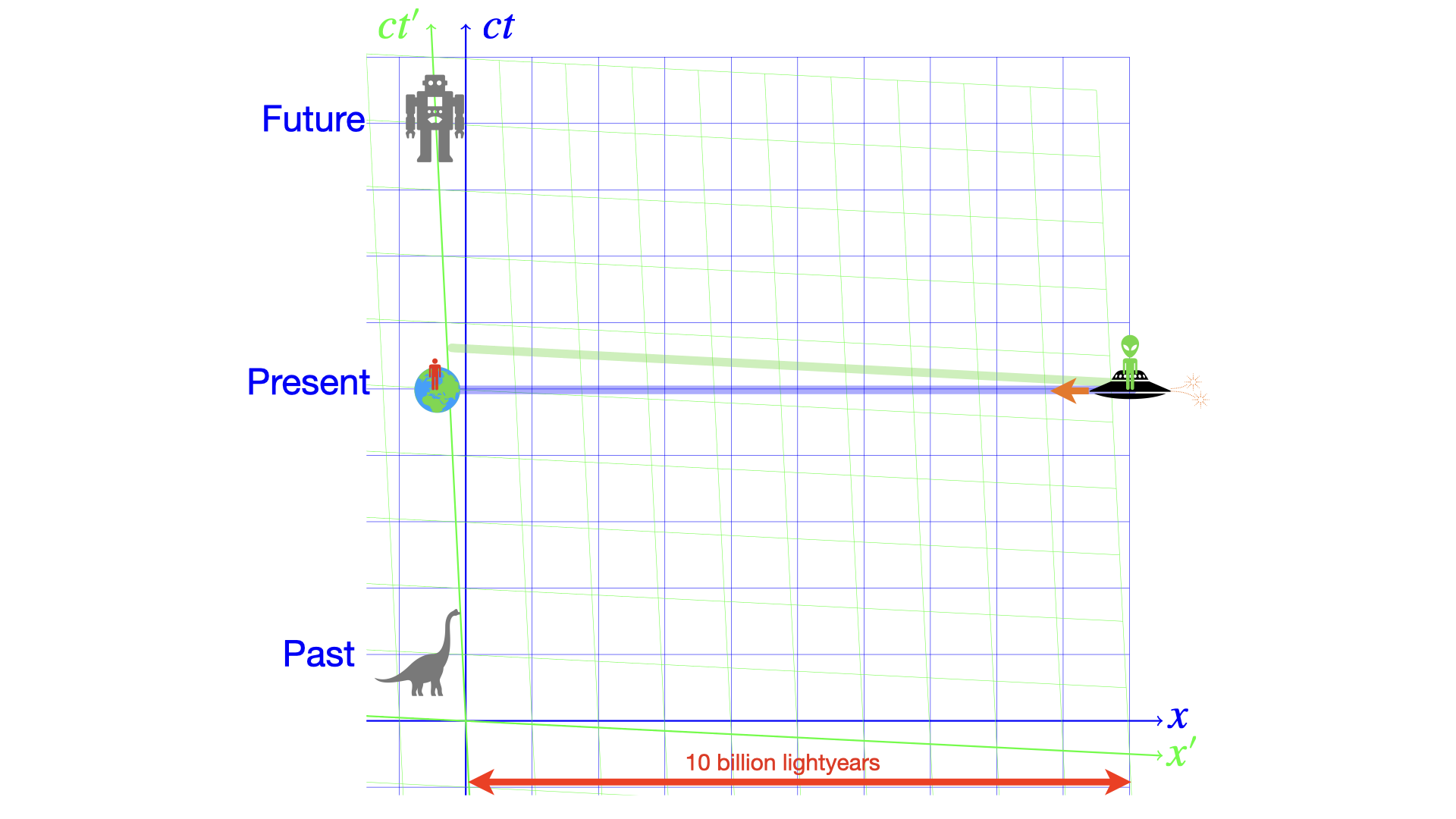
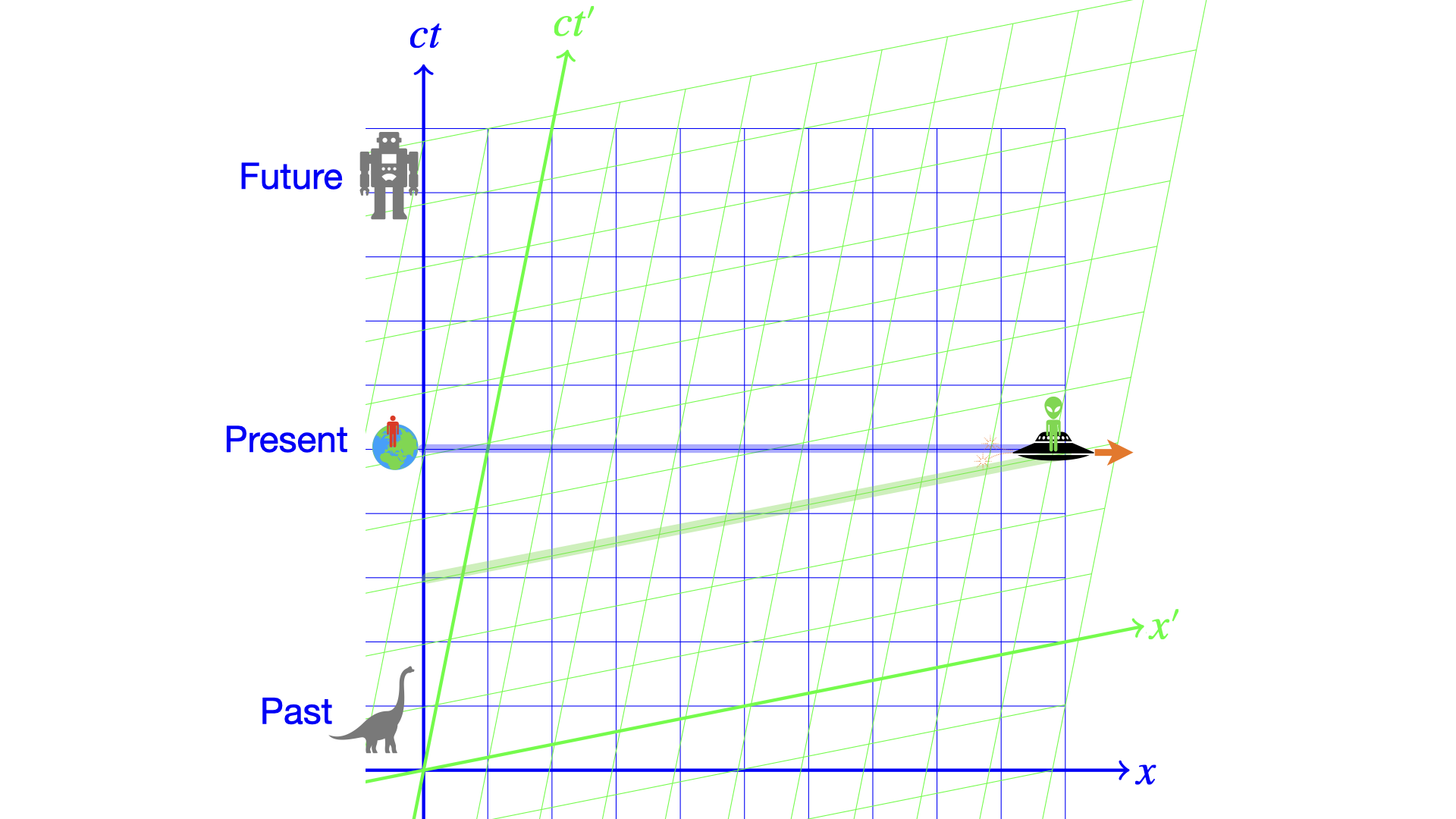
Increasing the relative speed makes the effect even more dramatic, so that the shift could grow to tens of thousands of years, or even more, as shown in figure 6. The alien’s present could then coincide with a time when humans on Earth still hunted mammoths, or to events many thousands of years in our future.
These astonishing conclusions naturally raise an important question: Before the alien started moving, both observers agreed on what belonged to the past, present, and future. If changing velocity alters that division, could the alien somehow interfere with our past?
Fortunately, the answer is no. The apparent paradox disappears once we remember that information cannot travel faster than light. Although the alien’s present may include events from your past, the alien cannot actually observe said events at their “now” time – let alone influence them – since light from Earth would need 10 billion years to reach the spaceship and vice versa. Likewise, even if the alien’s notion of the present includes events that we regard as belonging to the future, the alien cannot learn about those events before the information has travelled to them. Thus, communication with anyone’s past is impossible. Any message sent by either party must travel at maximally the speed of light and therefore requires billions of years to cross the enormous distance separating the two observers, and by then, the past has long gone.
So, does the future already exist?
The thought experiment described in Greene’s book ultimately leads to a profound philosophical question: If different observers disagree about what is happening “right now”, and both descriptions are equally valid, does it still make sense to think of the present as something unique and universal, as the only thing that “truly exists”?
What is beyond dispute, is that Einstein’s theory forces us to rethink the idea that there is a single, universal “now” shared by the entire Universe. Instead, different observers can make the slicing between past, present, and future in different ways. Whether this truly means that the future already exists is however still an open debate among physicists and philosophers.
[1] In this article, we only consider the special theory of relativity, meaning that in particular we will ignore any curvature of the space-time that makes up the universe. The general conclusions we arrive at are still true in a curved universe described by general relativity, though.
[2] To avoid confusion, note that in Greene’s video, time runs from left to right, whereas in the diagrams in this article, time runs from the bottom of the diagram to the top.
[3] To phrase this very carefully: start with one event that for us occurs “here and now”; say: you snap your fingers. Then consider an event that from our perspective is simultaneous to this, but at the alien’s location – the alien blinks their eyes, for example. We call this event “now” as well. Then, we switch perspective to the alien, and consider all events that from their perspective are simultaneous with this “now” event (blinking their eyes). This then includes events at our location, but from our perspective those events are far in the past.